The project is scheduled for release this MAY. It includes a deluxe limited edition hardcover. There is also a 14-track album featuring original music and spoken word. Additionally, there is a signed limited art print of the cover illustration by renowned Scandinavian surrealist painter Katarina Anderssen.
The Mass market digital edition is out in April, but I’m only signing the $54.95 limited edition. $34.95 for the cheap, print on demand edition out in April, 2025
Original cover by Norwegian Surrealist Painter
Katarina Anderssen
(Also available as a fine art print, signed and numbered by Katarina )
Original music and spoken word album composed by the magnificent Israeli Jazz composer Gilad Atzmon available in March for download, CD and Vinyl entitled The Broken Star, a musical and poetic indictment of the current state of Israel.
Album cover design by the designer, illustrator, comics artist, visual god Dave McKean. (Arkham Asylum, Sandman, Cages).
International signing and performance tour of Spoken Word and Live Music coming in the Spring of ’25
This is Art. Sample the Stone Soup:
Rumi’s Mirror the reflection of a reflection is your reflection. upon the mirrored surface of a pool, that is being slowly filled by the very source of the life you reflect upon
Now jump in the pool!
Music by Gilad Atzmon Digital Graphics by Mayssan
Modern Haiku A boy goes to school And tears his schoolmates apart With metal piercing bullets.
This is normal now.
Facing the Waves Waves are your faces Crashing in real time, Raising the tide Against your complacent shore.
Waves are your faces Curved towards you: White-bearded men, Relentlessly knocking on your front door
Reality, an unknown intruder Upon your inner core, Beats rhythmically, poetically, Drowning you in what you do not know.
Waves are your faces Melting into one and the other; Beating, imploring you, To open your locked front door
Waves are your faces Beating on your front door Eroding your discomforts Seeking to drown your inner core.
Beating senselessly, endlessly Against locked doors, Waves are abandoned faces Beating on your front door.
(Email info@themissionarts.com To be added to our pre-order list. order in January for a 99.50% discount!!) Look for it sweetheart, you ain’t seen anything like this before!
(Email: igor@themissionarts.com To be added to our pre-order list order in January 2025 for a 99.50% discount!!) Hey, No one does math the way we do!
prelude to the storm San Diego is a city-by-the-sea with a population of 5 million. It has spaghetti freeways numbered like 5, 8 and 805. These firmly establish the metropolis as a driving town. I grew up in San Diego in the 60s and 70s. We first rented an apartment in Point Loma named Loma Palisades. I attended Barnard Elementary School, which has since been converted into high priced condos, like everything of value in San Diego. Life was relatively laid back. The beach, particularly Ocean Beach, was close by. I began attending the early Comic con meetings in Ken Kruger’s science fiction, comics, and porn bookstore. My new friend Barry Alphonso joined me at the nerd-meets. The founder Shel Dorf would regularly give his moral sermons to us geeks, freaks, and comic book hounds.
I didn’t actually read comics at the time. I was kind of snobbish about them. However, my friends Barry and Bryan Smith did. They consumed comics ravenously. My parents didn’t give me an allowance. They were strict about where their kids spent their hard earned money. Science Fiction was another story. This genre I consumed like a dehydrated camel at an oasis. First Edgar Rice Burroughs and A Wrinkle in Time but soon it was Harlan Ellison, Theodor Sturgeon, Arthur C. Clarke, Isaac Asimov, Philip K. Dick (who I barely understood), Philip Jose Farmer, Kurt Vonnegut and then there was Ray Bradbury. Of all the fantasy, horror and SF authors I read, it was Bradbury who spoke deepest into my soul. I saw Bradbury as a kindred spirit. Along with Baudelaire, Poe, Rimbaud, Malarme and Zola who I also consumed with ravenous glee.
But Bradbury’s poetic novels forge my writing and poetry to this day. The Illustrated Man, The Martian Chronicles, and the devastating Something Wicked This Way comes. These stories infected my dreams. I recall having vivid dreams of sitting next to the illustrated man. I also dreamed of being on the carousel of youth in Wicked and meeting the Martians on Mars. It was his short film “Dial Double 0” about an actual artificial intelligence (NOT that misnomer marketing term AI!), born in a phone box haunting a terrified man with phone calls that animated my imagination. That and the first series of Star Trek (yes, I am old enough to have seen the first series when it was broadcast, sitting next to my dad who was equally mesmerized by heroic space exploration. My actual dad and I bonded over Star Trek AND Ray Bradbury.
Deeply profound imagery, is what Bradbury delivered and my being the son of a painter, it was the paintings he put in my head that I could not get enough of. My father, a professor of Anthropology at SDSU, encouraged me to read. He had taught me how to read English. I learned Spanish first in a Costa Rican Catholic school. My father loved Science fiction, being a scientist and he reveled in the fact that I would empty the SF section of the downtown library every two weeks when we took a family outing to the library. I eventually met Ray Bradbury at the age of 14 (or 13). It was thanks to my serving on the Comic Con steering committee. Walking up to the man in the ice cream suit and white fedora took all the nerve my nerd self could muster. He was standing by himself on the first morning of the Con, next to the El Cortez interior swimming pool. (Not in-door, but outside under a windowless sky light in the center of the hotel lobby. I walked up to Mr. Bradbury in terror. Here was this magician, this shaman of words who had entered my dreams at night and took me to far flung peaks of aesthetic bliss mixed with mystery and terror. Of course Mr. Bradbury was always Mr. Bradbury to me. Even when I got older and saw him briefly before his death, I never called him ‘Ray’. I deemed it to be a desecration of his powers.
I did summon the nerve to get him to sign my first edition paperback of Something Wicked This Way Comes and found him shining his benevolent smile into my eyes and face. He wasn’t a powerful, dark, intimidating wizard after all! Ray Bradbury was a kindly, warm, sincere man who cared about his fans. The artist as saint. He returned my paperback to me and smiled. I knew that I was safe from his dark magic. I could venture to ask him what I really, desperately needed to know.
“Mr. Bradbury”, I said before he turned to go to attend to his convention duties. “Mr. Bradbury, can I ask you a question?” Ray Bradbury stopped in his tracks. He turned back towards me. Leaning over my form, he replied, “Why of course, young man. What is it that you would like to know?” I hesitated for a split second. It occurred to me that he was mentally anticipating a question about one of his stories, some character, or plot twist. But I had a bigger question in my 14 (or 13) year old hungry mind.
“Mr. Bradbury, tell me, how can I become a writer like you? Is there a special school I need to go to?” Now it was Ray Bradbury’s turn to be enchanted; by little old me. Mr. Bradbury motioned me over to two pool lounge chairs cruxed by the blue fluoride pool of creation. He sat down and faced me. He examined my face intently. Then he uttered these words: “First, young man, you’ve got to get the name of my profession correct. It’s not writing, I’m not a ‘writer’, I’m a re-writer. The vocation is called re-writing for a very good reason. Because that, my son, is what you’re going to spend most of your waking life doing. Some of your dreaming life as well!” I became so mesmerized by meeting my hero. I didn’t remember what he said after that. It was about a 20 minute conversation and then he left to attend to his celebrity duties.
And That, My Friends, is how I became a writer. I was baptized by the worldly experience of a kindly, white-haired, be-speckled magician. He wore an ice cream suit and a white panama hat in the San Diego sun that blazed all around us, through the skylight at the very center of the El Cortez Hotel in the summer of 1972 (or 73). The El Cortez Hotel of legend, mystery, and comic book panel has become over-priced condos. This change happened because money is money. Culture and history are really just for the poor.
THE REAL STUFF NOW: (Hold onto your Horses!) As the previous heading sign-posted, this was all just the prelude to the true subject of my dissertation:
Which is in fact, the Poetry Futures Poetry Festival I attended only yesterday, hosted by the San Diego Poet Laureate Jason Perez and held at the Cross Cultural annex of the UCSD campus. There was no publicity covering the event, no posters or flyers to guide the poesie aficionados, but I was able to navigate my way to the upstairs set of conference rooms.
On my way up the stairs I found myself at pace with a young, well dressed Asian man with horned rim glasses. I asked him if he knew where the poetry festival was being held. He smiled an affable smile. “That’s where I am going as well,” he said. He reassured me that I was heading the right direction through this academic labyrinth.
Upon entering the reception room and pausing to shake Jason’s hand to thank him for inviting me, I found that the horn rimmed well dressed Asian man was actually the poet Lee Herrick! The Poet Laureate of California! Which I really cared nothing about. What I cared about was that he was an honest, good poet who had truth to tell in his writing. I had only read a few of his poems in an academic journal but he was the real thing. An adopted Korean child who had grown into a gentle, sensitive man.
Lee was not only a formidable wordsmith but the very man I had wanted to connect with in order to further my plans for the first international poetry festival to be held in San Diego: The Balboa Park International Poetry Garden Festival .
But more about that later. I plan to leave San Diego in 2025. However, I am also resolved to leave a lasting monument to the culture of quality in literary arts. A yearly Poetry Festival could continue long after I relocated back to more civilized climes. In conjunction with the festival, I also want to organize a poetry competition. The proceeds from this competition would go to building a Rumi’s Poetry Drinking Fountain in the center of the Prado. This fountain would be accessible to the general public. It would feature a stone sculpture of the Greek Pegasus, the symbol of poetry.
Donald (Dumb Hitler), Trump’s triumph in last November’s election convinced me. I realized that I was no longer suited to the American nightmare. For the first time, he secured a majority of the popular vote by only 175,000. I knew a nightmare was about to be unleashed. The day after the tragic election results, I made two long distance phone calls:
The first to my ex wife, Felicity Brooks, the Managing Editor of Usborne Books with whom I had a tempestuous separation some ten years previously. As soon as she answered the phone, I didn’t have to say a thing. “I’m so sorry, Igor, I’m so sorry about is happening to your country. What do you need to get out? I’ll help you with the home office to re-establish your residency and your work permit. I’ll even tell them that we’ve reconciled and are back together as a married couple. “Whatever it takes”, she continued.
“I’m so sorry, I know that you loved the US but the time has come to make the hard choices you have to make to survive”. My heart leapt at her kindness and generosity of spirit. How many men can count on their ex-wives as reliable friends? But I also understood what she was saying and why: Both of our parents had lived through WWII and understood the reality of political upheaval. They knew the plight of refugees escaping political oppression and tyranny. Now it was my turn to be a political refugee. My ex-wife knew that some forces in life are stronger and more important than mere marital squabbling.
The second call I made was to my never-actually-met-him Facebook friend, the musician Richard Torres. Richard was a punk rocker in the 1980s London scene and had had a hit. A big hit. But bad punk rocker that he was, he didn’t spend all his money on drugs, alcohol and womanizing. Instead, he betrayed his genre by buying a mansion in the Gothic quarter of Alicante, Spain!
What a loser!
3 years ago, I was illegally evicted from a house in Clairemont. This was after the passing of Louise Karsten. She rented me a cheap room in exchange for tending to her massive yard and building a vegetable garden. I also paid for the restoration of one of her three bathrooms. I had found myself vaguely homeless. Couch surfing from friend to friend and eventually anchoring myself to the outdoor couch of my bike mechanics overpopulated two bedroom rental.
His family and he were avid meth consumers. Every morning, I used the bathroom coming in from the front garden. I would be greeted by billowing clouds of smoked speed. I was invited to partake. Eventually, my polite abstinence proved to be an unalterable faux pas. I was inevitably asked to leave for not conforming to the social norms of their meth-smoking “community”. Which is directly relevant to my account of this festival.
After shaking hands with Lee, I wandered through the space. I was looking for poets to invite to my festival. They could teach as guest teachers at the Pegasus Poetry Workshops. It starts the last day of January 2025. They might even contribute to my new poetry journal, The Mission. I began to recognize some familiar figures of the San Diego Poetry “scene”. Poetry Underground had constructed a long table promoting their books and events. I avoided the eye contact of Anthony and “Sunny”. My last encounter with them was when they barred me from their underground open mic poetry reading. It was because I read my anti gun poem. THE BULLET FROM MY GUN. Anthony and Sunny founded Poetry Underground. They are proponents of the school of thinking that believes everybody who even tries to write a poem deserves accolade. I’ve always believed in support and encouragement for young artists; but support without critical discernment, without discipline, is no support at all.
Poetry takes work, not complacency. Each to their own but Poetry Underground’s so called “mental health” agenda leaves me a little bit worried. My concerns might not have a cause. However, it’s healthy to recognize your limits. By doing this, you can surpass them and grow as an individual and an artist. The slogan for Pegasus Poetry Workshops is straightforward. Poetry Underground blatantly rebuffed it. We will teach you the rules of poetry. Then, you will know how and when to break them. Poetry is not a nightclub, it’s a hard earned craft that requires discipline, focus and dedication, not constant applause.
My anti gun poem I read at my last ever ™”stand up tragedy” at Poetry Underground is reproduced above.
Anthony had took umbrage at my poem and its contents. He was especially upset at his audience’s reaction.
The audience was visibly excited by my heart-felt honesty. I had exposed the mental problems of gun obsessives. My poem highlights their detrimental impact on American society. We have too many guns and not enough gun control. The number one cause of childhood mortality in this country are gun deaths! That is obvious even to servicemen and women. However, Anthony did not see it that way. As MC, he seized the stage after my performance. He denounced my poem with a tirade about Second Amendment rights. My poem called out the gun nuts who want to spread even more death and mayhem. Gun violence is a reality, not an opinion in America. We experience a pandemic of gun violence every day in the US. This is a fact, not a perception. Gravity can be an experience, but it is not a perception or an opinion.
It is the truth.
I was pleased that my poem had triggered (sic) some kind of reaction but Anthony was adamant in his denunciation. As an ex military type, he had always eyed me with suspicion and barely concealed hostility. He could smell my liberalism and it made him sick. Some time later, I called Sunny to invite her and Anthony to my Pacific Beach Poetry Workshop. She found my invitation insulting. Her attitude towards me was evidently infected by the same hostility. She informed me that if I decided to return to their open mic ritual, “Anthony wants a word with you, first.”
That was enough for me.
Unlike some of the aspersions cast in my direction, I am an adamant pacifist and avoid conflicts at all costs. What I have learned is that if you turn away from “trouble” to avoid it, “trouble” will often follow you down the alley way anyways. It might even mug you from behind!
Needless to say, I never returned to the Underground. (Take notes, Dostoevsky!), These days, I keep my feet above, not under the ground.
The Poetry scene in San Diego is parochial at best; and that, relatively speaking is a compliment!
San Diego as a whole, is a metropolis sized city with the mentality of a small town. It has no real literary or arts scene comparable to San Francisco, LA, Oakland, Sacramento or even Fresno. In Southern California, artists are seen as stunted adolescents. They are treated as if they won’t grow up and get a real job packing groceries at Whole Foods. Most other major California cities have thriving poetry and expressive arts scenes. Poets stand together in brother and sisterhood and help and support each other.
San Diego Poetry “scene” has been and is still, more like an open dog fight between warring and self-aggrandizing factions. The gatherings and readings tend to be mutual admiration clubs of gratuitous glad-handing applause. It reminds me most of the participation awards of the 1990s when everyone wins just for having partaken. On a few occasions, I’ve heard a young poet with promise recite an amateur piece. I approached them afterward to encourage them to “Rewrite” and think about who they are writing the piece for. I am then admonished by the host poets and told off for being “negative”. Critical thinking is abhorrent to the San Diego poetry scene. Writing is too.
Curan was a rare exception. Sadly, he is now deceased. He was a white Buddhist gay poet. Curan ran the Mission Hills Library monthly workshop. He was genuine and real and we are publishing his work now posthumously in The Mission monthly. Curan was the exception. The rule in San Diego poetry readings is that there are featured “stars” backed by their publishers to sell products. And there’s the so-called “Open mic” monthly gatherings guaranteed for applause. This is regardless of merit, and discussion or feedback is profoundly discouraged. At one such “open mic” reading I asked the assembled audience of would be poets, to hold their applause. That if they wanted to give me feedback to approach me after the reading and tell me what they honestly thought. This caused the bah-bah-ing, amateur sheep to deride me as I was challenging their ritual. The veterans at the same reading openly mocked me for even suggesting such a trespass of their precious norm.
All of this petty-clique behavior is more worthy of a bad high school TV drama than a literary tradition. This has inevitably led to an impoverishment of poetry as a craft in San Diego. A vocation which in fact takes literally decades of hard work and endless failures to achieve anything of merit. Art is a vocation, not a dilettante’s hobby.
The owner of Verbatim Books was at the festival, there with her entourage. Of course, she avoided my path. I had tried to get her shop to stock my books. Then, on one occasion, I invited a homeless street poet reeking of alcohol. Former Beat Poet Laureate Chris Vannoy and I had heard him reciting incoherencies outside their reading. We asked him to come inside and recite his insane, psychedelic, beautiful ramblings. The owner did not take kindly to what she misconstrued as an attempt to sabotage her event. Apparently, you can’t be drunk and read poetry in San Diego. Sorry, Charles Baudelaire, Dylan Thomas, Charles Bukowski. You’re not wanted here!
After Avoiding the Poetry Underground & Verbatim, I said hello to Ted Washington who was going to be reading for the Fighting Poetry panel (which was my highlight of the festival. Ted and I have known each other for years. We do detect that we’re not exactly friends. However, we do share a begrudging respect for each other’s work. I would publish Ted Washington in a blink. His voice is angry, political and authentic, an African American raging against The Machine. Hey, we don’t have to be “Friends” with everyone. People don’t have to “like” each other; we just have to not kill each other. Poetry is a forum, a medium of expression wherein people with differences can air those differences in lyric, rhyme and reason. Jason’s Poetry Futures festival proved to be just that: political, engaging and inspiring. I met some great poets and some great human beings there. Mainly from LA, Portland, Anaheim and the Bay Area. I found myself applauding loudly, wildly at the voices of mainly women poets. I also found myself randomly running into complete strangers. We would exchange a line of verse in rhyme and reason.
“Strangers stopping strangers just to shake their hands.” Robert Hunter
The out of town readers were amazing, truly wonderful, sending shivers down my spine and music to my ears. In contrast, the academic poets both students and teachers, presented a stark contrast. Some of the UCSD graduates buried themselves in their own self-righteous academic graves. They pronounced their degrees like ancient Egyptian curses. These poets tried to conjure magic that wasn’t theirs or of any lasting potence. At best Art and Academia are uneasy bedfellows and can lead to abusive relationships as the only steady income an artist can muster while they perfect their craft is by teaching. Which is fine except that higher education in California (and probably throughout the US) is a business. The products are students and credentials that lead to paying jobs. That can be alright except when the credential is a token of conforming to an inorganic, bureaucratic entity that just wants to control the thoughts and actions of others. That’s when the relationship between art and academia becomes an abusive co-dependence.
Unrelated, Michael Klam and his San Diego Yearly Poetry Annual entourage of county editors were there too. I like Michael, even though I don’t have to. We’ve had over the years, a disagreement or two, but he’s always remained an affable sort. Besides, the Annual has published my poetry 4 years running and you don’t shoot the horse that lets you ride him. I gave up submitting to the annual a few years back mainly because ones poetry gets lost in its voluminous thickness. I don’t really know who actually buys the annual apart from the poets who are published in it. Some of its editors are friends and support what I do. Others despise me for my work, my dedication to critical thinking and my politics. I am devoted to Poetry and this poet’s life like it was my parent. Having lost both, Poetry has taken their place in loving me, in caring for me; poetry has nurtured my body, soul, and mind; without it I most likely would have taken my own life years ago. (If not for my daughter Olivia as well; who I could never inflict such trauma upon.
In the end, it is our children who save our lives from dissolution and despair.
The San Diego poet I now most admire is Sonia Gutierrez, who recognized me when she was first approaching the center, outside while I spoke to an Arab who happened to be the buyer for the La Jolla Barnes and Nobel and who I had given a copy of Is She Available? and was raving about it, asking where he could order more copies for his store.
Sonia Gutierrezwasn’t quite sure where she recognized me from but insisted that I was familiar to her. She asked me a question about where the event was (Signage, people, signage!!). Sonia Gutierrez peered at me and told me that I looked familiar. Later when I heard her read at the Fighting Poetry panel brilliantly hosted by Ted Washington, I recalled that the great Mexican muralist Victor Ocheo had introduced her to me over 5 years previous. Victor was always pushing me to celebrate my Latino, Costa Rican heritage. My uncle being the now deceased Costa Rican muralist, painter and sculptor Francisco Zuniga. (I come from Art Aristocracy!)
He wanted me to connect with other “Chicano” poets. This was the very first occasion I heard Sonia Gutierrez read. I was literally and pleasantly blown away. A non academic, self taught poet. She is now a poetry teacher. She exuded her culture like a wafting perfume. There are too many phony Chicanos in this world; too many Latinos laying claim to a uniquely Mexican American heritage. People like Peruvian painter Mario Torero who insists that he’s a Chicano “Artivista” when there isn’t a drop of either American or Mexican blood in him.
Sonia Gutierrez filled the room with sounds and almost smells of her Mexican heritage. She is a real poet in every sense of the term, as she serves her words up as a vehicle for her people’s history, her people’s culture, her people’s sounds. A woman’s sounds (like my mother singing in the bath tub, cantina songs), I wanted to embrace Sonia after her reading; and breath all of Mexico in. Instead, I invited her to come teach at the Pegasus Workshop as a guest teacher and gave her a blank cheque as to how to fill the two hours. I admired her spunk. She bluntly asked me if there was a stipend for teaching. There is not, as the workshop is a semester long and free to the public. The event is held on the premises of a public building, which the tax payers pay for. Poetry should be free. Poets do have to eat. Their words may feed the spirit, but the flesh is also wanting. Poets should be paid for their work. Buy their books, it makes a big difference!
So I told Sonia I would see what I can do. Her poem “Perspective” should be mandatory reading in San Diego’s classrooms. It is a monument to hypocrisy. It highlights the disingenuity of the new right as they sabotage our thinking, our ability to reason. They gaslight us into accepting racism and bigotry as just a matter of “perspective.” In today’s post Trump intellectual wasteland, all opinions are valid even house that would strangle opinion at its source.
Sonia Gutierrez filled the room with sounds and almost smells of her Mexican heritage.
The panel called Fighting Poetry was a little distracted by a ‘transitional” (transgender?) poet, who’s name escapes me. She was a striking woman with a beautiful face. But the transgender poet had marred her own face with a frozen smug, plastic smile. I have had friends within the transgender “community”, (Not my choice but It is their’s and I would fight to protect that human right.), But there was definitely something false, something wrong with this particular poet’s self presentation. She proclaimed the righteousness of her gender choice as if it was a weapon to be used on her audience. Her answer to fighting poetry, in which real truths were being told, was to lead the group in a contrived “breathing exercise in an off-the-shelf mindfulness.
Her poetry was mediocre although her pain and composed anger were real enough. If she had not taken affront I would have shared with her some constructive feedback. The politics of sex, of gender, and identity are volatile like nitroglycerin. A single misstep by a boring straight man like me could spell disaster. I chose to avoid the risk of confrontation.
A young Vietnamese poet, whom I have lost track of and could not find, breathed air into the room. She did this by reciting a poem that mixed English and Vietnamese words. The music beautifully infiltrated the comprehension of the poem. I am a devotee and follower of Thich Nicht Han, the monumental Vietnamese Zen monk. I have met, sat, and walked with him in London. I was well disposed to the sound of her vowels. Even without understanding the meaning of her words, they were sheer poetry.
The highlights for me were Jason himself. He bid farewell to his position as poetry laureate. Then I was captivated by the sublime psychological work of Lee Herrick. I had only read him before and never actually heard him read. His voice opened up his exploration of his own heritage, his own adoption and adaptation to my heart.
A lesson for us all: if you can always hear the poet read his or her work aloud, do it! The human voice carries the breath of the soul. Like Homer, we are all blind to the written word when it can instead take flight. It flies on the winds that come from within us into the wide, wild world. But don’t believe me when I sing Lee’s praises; Listen for yourself. Listen to the wings of poetry unfold and take flight!
Experience life’s moments on your own. The universe doesn’t expect much from us but it does want us to pay attention and listen….just listen. Thank you for reading this far, now please if you will, comment below.
I have only had two editors in my life. One was the now deceased artist Eleanor Brooks. She was the widow of the great novelist Jeremy Brooks, and a friend of Ken Kesey’s and Robert Stone. Eleanor was a British Beatnik, an official Friend of Wales, and a former Duchess of Gloucester. She renounced her title and seat in the House of Lords to marry Jeremy, a commoner.
The other and now my current editor is Dr. Miles Krogfus. He won first place in a national poetry competition back in the 1950s. This achievement paid for his entire university education. AND his PHd in Yeats, an the Romantics. At 83, he can detect the Classical within the contemporary. He keeps my poetry disciplined within the legacy and structures of poetics.
Part of The Mission is to publish the monthly Mission. My newly incorporated company will include comics, poetry, prose, and art. Mile’s work will feature in it and then after a year, we will publish a book of his poetry.
Not for his sake or mine. For the sake of the American people. This is especially true for Americans under the age of 30. They have been denied the richness of art and culture. They continue to be denied access. Art and culture are how any civilized society tends to its emotional and psychological challenges.
I am utterly certain that many Americans are mentally ill due to poverty in arts and culture. Some are lethally so. This society has ultimately commodified arts and culture into extinction.
It is difficult to pursue a career as an artist anywhere. However, it is next to impossible in America. It didn’t always used to be this way. It’s a change I’ve seen happen slowly, really just in the last 40 years. The only socially acceptable vocation in America today are institutional ones or corporate jobs. Or science, engineering and technology. because we value our tools more than we do our fellow human beings.
We treat dogs like people and people like dogs in America.
Anything else is derided as “not a real job”. With the rare exception of musicians and recording artists who are viewed as potentially money-spinning. Painters and writers and sculptors are treated like complete shit. We are advised to stop practicing our craft. Instead, we should get jobs loading paper bags at Trader Joe’s for rich hippie vegan scum.
Once when I was being processed after being arrested in San Diego for one of my many nefarious crimes (I will die before I tell them where I buried the 4th body!), I was at the booking desk and I was being asked what profession I claimed, I said “Poet” and the desk sergeant guffawed, laughed loudly and turned to the other deputy as they both belly laughed.
THAT is what Americans think of and how they treat the arts in this tragic land.
All to the detriment of the mental health and well being of our society. Yes, the word ‘Society’ does actually refer to a real thing, you just can’t buy much of it.
The last time America had an arts-based culture that pervaded society was from the late 1950s until the dawn of the 80s. This culture was admired and emulated by other cultures far and wide. Whats loosely referred to as the 60s. Nobel Prize Winning Poet Bob Dylan completely revolutionized the music industry with his songs and music. He turned the Beatles onto LSD, and we all know where that led: cultural, spiritual, and social Revolution!
Ken Kesey wrote Sometimes a Great Notion and then Cuckoo’s Nest, was experimented on by the US military with LSD and decided that not only did he like it, he would give it to everyone else!
And the Merry Pranksters and the Grateful Dead were born, Giants of cultural upheavel and enduring art. Yes, I’m saying that Jerry Garcia wasn’t just a great guitarist like Jimi Hendrix. (Another America icon to the arts, our “Mozart” of the electric guitar.). He was an artist plain and simple. He intuitively grasped the dream nature of art, how to embrace chaos and allow the growth of form to emerge out of content. There was nobody ever like his band The Grateful Dead and there will never be another like them. Jerry Garcia was a Boddhisatava who changed the lives, improved the lives, alleviated the suffering of millions upon millions of people. For which he took no credit or accolade because he knew that it wasn’t him,, he had no ego, he was just Jerry doing what Jerry wanted to do.
Because “if you’re not having fun doing what you’re doing, you’re not doing it right!”
Jerry Garcia and Ken Kesey were artists using humanity and the people as their canvass. They improved people’s lives, period!
Ornette Coleman, John Coltrane, Miles Davis, Ton Carter, Sonny Rollins, Lee Morgan, Anthony Braxton (and too many more black musicians to list here), took the suffering and political humiliation of the African American people, absorbed it deep within their soul and then produced something more beautiful, more African American, more valuable than all the suffering of all their generations had endured could quell: Modern Jazz. The only uniquely indigenous American cultural product, ever. And it was our underclass, our N**g**s that produced it, that created our cultural heritage
White folk produced it and took most of the money and sometimes, on occasion aligned with it in emulation and imitation. But it was black people, African Americans who created it, from the blood and sweat of their masters lashes, the only lasting cultural worth America has every produced.
The Blues and Jazz will endure all of us for the next 2 thousand years. If humanity still exists in 2 thousand years, you can be certain. They will be listening to Jazz. Maybe ‘their’ Jazz, but they wouldn’t be listening to anything without the creative fountain of the African American artist.
Andy Warhol, Georgia O’Keefe, Jackson Pollock, (and please list painters that changed your life in the comments) didn’t just create visual art that sold for high prices. They changed the way people SEE and think about art. Consequently, they altered the way people viewed their lives as they are living.
Charles Olsen, Alen Ginsberg, Gary Snyder, Walt Whitman, Eugene O’Neil. John Reed, Dashiell Hammett, Raymond Carver, Carolyn Forche, Jack Kerouac. Lillian Hellman, Shirley Jackson, Dorothy Parker, Gertrude Stein, Bessie Smith. Billy Holiday, Lenny Bruce etc. etc. etc.
These were all writers and artists creating the raw material that makes up our soul. They weren’t just singing songs or spinning rhymes. They offered up, from the depth of their souls, the remedies for living. They provided the cure for our social illness! They taught us how to live better. They guided us in leading more rewarding lives. They helped us overcome the slings and arrows of our outrageously over-priced fortunes.
They were and still are our shamans. They are our urban witch doctors, our counsellors, and our therapists. Without them, without more generations of artists, we are all going to languish. We will whimper and suffer in our straitjackets, in one big WHITE lunatic asylum. It is ruled by the insanest WHITE king of them all: mad Donald Trump.
Today “art education” consists of “you better pick up a skill you can fall back on”. It has taken me 40 years of hard graft. Daily work, rejection, and overcoming rejection have brought me to this point. Now, I can look the cop in the eye. I can proudly say, “yes, I’m a poet, I’m an artist. You gotta problem wid dat”?
These days I mainly talk to young people, meaning people younger than me. Guys and gals, working odd jobs, standing outside of restaurants barking customers. Because San Diego is so fucked up, the management gets weird when I talk to young women my daughter’s age. People give me hostile looks. I’m asked not to return to the establishment to spend my money. Generational isolationism is a real social problem in San Diego. But I don’t give a shit, I’ll talk to whomever, whenever I want regardless of their age or mine. Unless they don’t want to talk to me and then I apologize and go away. But young people need their elders to give a shit about them, to talk to them to ask them what’s on their minds.
That is how a civilized, healthy society functions. You go to any other developed nation in the world. You’ll find ancient town centers in England, France, Spain, Italy, and Greece. In these places, the neighborhood’s children run free. Their parents sit at outdoor cafes or at tables or around fountains gossiping away. The children run free, feeling both free and safe. They know, without even being conscious of it, that they are the village’s children. They belong to the community, and the community will care for and protect them.
Socialist? You’re damn right that’s socialist. It is much better and healthier than the fear and paranoia that dominates current American parenting. Our teachers are prison guards. Our parents are overworked overlords. Our police are soldiers. They view every citizen and every member of the public as an antagonist. How many cops does it take to change a light bulb? None. They’d prefer to just beat up the room for being dark!
America has lost its soul along with its way. Now it is just about the money; not even about what the money buys, just the frigging money.
When I last ran a company (or more accurately, ran after my company to make sure it didn’t go off its own rails!), I used to hire what were then a new breed of worker: the code, the computer programmer, the software developer. This was very difficult for me. Although I served my investor’s interests and followed my detailed business plan, I knew little about actually writing code. At the time, I didn’t even know how to write html. It’s not a code, but a mark-up language for the web.
So I had to hire some dozen coders very quickly to execute an array of electronic publishing projects, on CD-ROM at the time as DVDs had yet to be invented. So I interviewed everyone who came to apply for a poisition as I did with all of my staff. Anyone who ever works for me, who is paid by me, has a direct contact with me. A direct human to human connection is crucial in order to maintain a cohesive working environment. I do not delegate Human Resources. Because Humans come first, before even the money.
So I would typically take two strategies to discern whether or not I wanted someone working with me. The first was to sit in front of a screen and a keyboard with the individual and ask them to show me what they did that affected the screen,. Like I was an idiot. I called it my “Colombo” approach.
If the young candidate (typically college graduates in their early to mid 20s), balked and told me that I didn’t know enough to understand what they did; or try to waffle me with computer code jargon or resisted explaining anything to me; I would thank them for their application and say I’d be in touch.
I never was ‘in touch’.
If you can’t explain what you do to a 12 year old child, much less your potential employer, then you don’t really know what you’re doing yourself
My second approach is relevant to the point of this essay. At the time I had secured over a million and a half £s in corporate investment. Enough to develop, produce and market an electronic publishing platform of 8 new interactive titles. I coined the term INTERACTIVE DRAMAS to avoid the computer game association. Ironically, it was the computer Game MYST that was our great inspiration. It inspired the development of these interactive titles. I had the superb artist, designer and my aesthetic mentor Dave McKean as my nonsalaried Art Director. I also had a team of hard working, London working class designers.
They were “My Boys”. (along with a couple of girls). My Boys is my reference to Garth Ennis’s superb comics series and now Netflix series (The Boys; highly recommended if you hat super hero movies as much as I do)
So I was a happening dude in London in the early 90s. Which was a success that was all too shortlived, as all successes ultimately are. Nothing lasts forever, baby, apart from the Moon, the mountains, the ocean and the stars.
But back to the interview process relevant to my point about money and its intrinsic valueless-ness. So I had a company cheque book at the time when people still wrote cheques. My candidate would come into my office and sit in front of me and I would ask the usual questions about their backgrounds and experience. Then we’d do the computer screen test. Finally I would lean forwards and look them straight in the eyes (and smile).
“Tell me, what is it that you really want out of life, what is the real reason that you’ve applied for this job; what do you want?” Without exception, the candidate would drop their guard and answer with one word: “Money”
And these were British kids, mind you. Working class, self-educated or middle class college graduates. Not Americans. With Americans, its ten times worse. Now the lesson would begin: I would smile and say
“But of course, what would be the point of going to a job every day if you weren’t being paid. I want money,, I like what money buys me”.
The informality would open the candidate up:
“I want loads of money, I want to be rich by the time I’m 30 and I’m so good at what I do, I’m going to make that real” (or some paraphrase to that effect). So then I would start the game. I would look seriously at the candidate and say: “Would you consider a million pounds enough money?” Inevitably, they would be confused by the question. I would repeat myself while I opened my desk drawer and extracted the company cheque book. “Would you consider a million pounds enough money to make you happy to achieve your dream?” The answer was always the same. So I would begin to write out a cheque so that they could see my writing, for a million pound on the company cheque book, logo and all. Then I would rip the cheque out and being to hand it to the candidate.
“I’m going to give you this million pounds, it’s yours and you can call the bank right here and now to verify that the cheque’s good. It’s a real cheque for a million pounds and I’m going to give it to you, right here and right now on one condition.”
The candidate was never sure how real this game was but they knew for certain it was a real cheque; one guy actually called our bank and was told that the funds were liquid. But I wasn’t taking any pleasure in the startled eyes and nervousness of these young people. Instead I had an invaluable lesson to impart.
“One condition and the money is yours”, I repeated. And I would hand them the cheque so that they could feel reality in their own hands. Some would ask “What’s the catch”? Some wouldn’t. Then I would explain:
“You can have this cheque. You can have a million pounds on one condition. You must accompany me directly to the airport. We will go without interruptions and with no stops. At the airport, we will grab the first flight to Cairo. Once in Cairo there’s a helicopter awaiting us (there wasn’t, I lied). The helicopter journey will take some 3 or 4 hours to the heart of the Sahara (‘Sahara’ means desert, so to say Sahara desert is redundant). Once we have reached the centre of the Sahara, we will land. Or we will hover about 5 or 6 feet above the desert. You will jump a short distance. The sand will cushion your jump. And then we are going to leave you in the middle of the Sahara with your cheque but no water, no phone and at least a hundred mile walk to the nearest oasis.”
And then the punch line, which I would deliver while meeting the person’s eyes full on:
“So what is your million pounds worth to you now?”
The AHA! Moment (the one word that Allen Ginsberg wrote on my first edition City Lights copy of Kaddish when he signed it and invited me up into his room; I didn’t go, its another story. Always been a touch homophobic)
The day to day epiphany available to all of us any time of day, “if you look at it right”. The moment of realization of enlightenment and understanding happens when you grasp not just something new but when everything you had been thinking crumbles away. Everything that you thought to be true up to that moment crumbles away. Those scarlet begonias are a touch of the blues.
And your mind is just blown wide open to the fact that what you knew was certain wasn’t very certain at all. You can’t hide that moment on your face. And I knew with utter certainty that the look on my candidates face was their passing grade. If they ‘got it’ I could work with them.
I’m friends with some of my ex employees to this day and recently one of them, a girl now a woman, reached out to me to remind me of my little employment game and how it made her start to see her life in a totally different way.
I told her that no thanks were needed. That I was just doing my job The best way I knew how. Thanks for reading. Leave your comments below and I will respond. Still human that way.
I swear listening in to this documentary it sounds exactly like my autobiography! Arrogance aside, I have yet to achieve anything even approaching the pinnacle of aesthetic mastery over the English language that Beckett achieved in his life time, but my aspiration and formative years in Paris are very similar.
In my humble opinion, Samuel Beckett was the greatest, most profound and impactful writer of the 20th century; if there could even be such a thing as a number one.
Like him, I too eventually skewed formal academia as too limited to reach the pinnacles of knowledge I wish to scale. I’ve always found academia to be a poor substitute for a real education and scholarly pursuit.
Too rigid and locked into its own political circus of bought credentials and peer review, where in your competitors get to judge your work and inevitably detract from it. Higher education is only available to those who can afford to pay for one and that in itself limits its virtues to privilege and social class.
Like Sam, I too have turned to art (first though the publishing industry), as embodying the best education a self-motivated scholar can pursue. There is no one to judge your work but the public who will either accept it by buying it or give you the feedback of ignoring both the work and you.
This is what the market is for: faceless, anonymous judges cloaked in long dark robes who sit in final judgement merely by virtue of their attention span.
They either get you or they don’t and if they don’t, it’s one’s own self that bears the blame.
The vocation of art is a noble one.
A lonely one, it is true.
It takes literally decades to get anywhere near the mastery of ones craft.
The living, selling, successful artist is a figure of endurance, one who has persisted beyond an ocean of failures to the remotest of islands where a little sun may some day shine down on him/her.
Where nourishment is reduced to whatever fish one happens on, in the sea. Perhaps some berries or figs or a coconut or two.
The only sustenance a career in art can bring is the nutrition present in the work itself. Be it writing, be it visualization, music, dance, theatre, media or another medium I can’t even imagine.
It is true of all art.
True art serves its own purpose; it is for itself and nothing else. Like a tree or a river or a boulder in the middle of the desert, it has no purpose apart from the expression of its own Being. Any “art” that is for something, e.g. illustration, decoration, entertainment is no longer art. It may be “artistic” in the language and meaning it conveys but it is not strictly speaking, real art.
Real art is lie a tree, a stone, a pebble, a cloud, a sand dune, a mountain, a river, an ocean or a new born child.
It is the work and the doing of the work that is the vocation.
Fame is for John Lennon and David Bowie to sing about.
It has no place in an artist’s cramped quarters, there’s barely enough room for love and respect.
Like my intellectual idol Sam Beckett, I have made great sacrifices to perfect my craft; and yet I am still lightyears from my goals. Socially, personally, emotionally and certainly financially impoverished, I have nearly lost my daughter on art’s sacrificial altar.
I am ultimately a Poet, a writer, a producer because there is nothing else I really know how to do. I am pretty good at making money for other people, but for myself, not so much.
I don’t take orders that I don’t understand.
I refuse to be treated as a machine and I generally question any authority that attempts to assert its will on me.
I am a free man, an outlaw and a warrior.
I have no choice but to pursue the vocation I was born to do.
Which I will pursue until I am dead.
I will emulate Da Vinci on his deathbed who legend recounts his last words to be “But I’m not finished yet! I haven’t finished!”
Nature is far more super than supernatural.
So when I am dead and buried (or burnt or lying at the bottom of the sea), my words, my projects will still be with and in the world. I will be immortal without having to endure the boredom of being awake for eternity!
My art is also poetry and short “fiction”. And I am head on confronting this very issue every day of my working life. I turned my back on academia where you can get paid to regurgitate curriculum while you do your real work.
Why? Because ultimately academia is a crutch that consumes your mind and soul after a while if you’re trying to be an artist. I call academia the artist’s meth. It feels great while you’re smoking it; status, paycheck, the admiration of the young….but ultimately your artist’s teeth fall out, you get uglier from compromise, and the admiration of youth makes you psychotic when you start actually believing it.
So I decided 6 years ago to starve to death.
No, let me tell you the truth. I determined that the undervaluing of poetry by the mainstream (commercial) was a social malaise, a symptom of a wider social problem compounded by the monetization of popular culture.
Cactus Flowers by Margarita Zuñiga. Fine Art for Sale: Enquire Below
I looked at who was actually reading and writing poetry first by hitting the poetry readings circuit. There I found the old clutching at reminiscences and the young clutching at life and strait jackets.
The number of young people 16-26 earnestly writing and writing confessional poetry struck me. Especially young women. They were confessing their angst and being young, about being raped, about being molested, about living in a world weighed down by the gravity of the male gaze. There were also cocky young men, rapping and slamming their hearts away.
So I started writing for them. The same age group that suffers from historic levels of suicide, anxiety and depression, gave me fodder for my writing. I wrote and read to them in public and my piece Suicide Note gained an audience of lonely girls who would approach me after my reading to highlight how that poem in particular struck them as they didn’t realize that other people felt as they did.
Someone I Missed
I also began carrying copies of my modestly selling my author copy books with me everywhere I went, signing and selling copies by hand at readings. But also if I met someone new in a cafe or party and the conversation got to the “and what do you do”? part, I’d answer, “let me show you” and pull out a copy of my latest.
“I’m a poet, would you like to hear a poem?”
IOW, regardless of the market, I decided to take my professional seriously and not try and disguise the thrust of what I do. I always have enough author copies of my books within reach so that when someone asks where they can buy one of my books, I list the usual Amazon, Barnes&Nobel, bookshops local to me and then I add “or you can buy a copy from me and I’ll sign it for you”.
At this point, I am ahead of the market because I have numerous direct contacts with my buyers. I talk to them. I find out who they are and why they read and what they need from an author.
Laborious, yes. Low yielding revenue, yes. Time consuming, yes. But I would match my market research on my audience against any data crunching publisher, any day of the week.
I am determined to make poetry pay. Not a lot, but enough to make a bare boned living at. I stopped buying things. I stopped trying to be middle class. I live in a meager apartment. I collect food stamps and any other government assistance I can talk my way into and I have absolutely no shame. The government is paying me to be a poet, a writer and an educator.
That’s my government subsidized job, in the long standing, centuries old tradition of the patronized arts.
There is never any shame in survival. How many fast food jobs did Socrates work? Or Ovid or Homer. Did Dante pack groceries at Trader Joe’s in one of his circles of hell?
Break Out!
I teach independent poetry workshops at libraries for non mandatory donations. I lecture on poetry. I do readings and signings. I collaborate with a music producer in Stockholm, Frederic Iriarte who records my readings to mix with his music and publishes them on line as albums for download streaming. Do they make any money? No. Barely enough to justify the effort.
But I am getting paid to write and read poetry, just not very well. I love my work and the place it puts me mentally and spiritually to labor through, more than the comforts of middle class continuous consumption I have had to leave behind.
I am totally dedicated to improving upon and perfecting my work for the sake of an unseen audience. For the sake of readers I haven’t even met yet.
I am not unemployed, although I collect unemployment. I write and teach poetry and writing. That’s my job.
Here I am: http//igorgoldkind.com
Igor, the Poet
Don’t get me wrong, it’s much harder to be an artist than a businessman. But over 6 years, I have built an audience. I have 5,000 FB followers, nearly a thousand subscribers on other media, including my blog.
I now run into people both on and off line who knows someone who bought one of my books. I also get anonymous phone death threats, obscene emails and am persona non grata among my local amateur poetry community.
But these are small prices to pay for being to hold up my head and answer “Poet” when someone asks me what I do for a living.
I like to add “But I’m only in it for the money”.
Rebecca Behar:
“Igor Goldkind You are just describing the life of dropouts who succeeded, why not – my best friend was like this, but she went to Italia. Depends on the place. Also in some countries you cannot do anything directly with a bookshop or a library – the distribution is perfectly controled, no freelance accepted.
But it does not matter, I belong to this underground and we did wonders, and now slam and spoken word are still great. So I agree that it is very difficult to kill poetry – like weed. But just compare with Victor Hugo – not only his poetry paid for a big house in Guernessey, but for his expensive way of life. And anyway he believed that he was a kind of prophet. But there is something else which is what ppl can accept and understand, called “reception” in general. I think that a real poet provocative and misunderstood by definition.
About an audience and ppl reacting, this became quite easy with internet, but again all these video kids are relying on marketing. My concern is that written, hermetic, creative poetry is obviously confidential. PS – I just visited an exhibition on surrealism, this is exactly what is missing : a big bang, a scandal, a movement breaking all this business & technology boredom. I think that it is happening in Iran, with the movement “women, life, freedom”.”
Rebecca Behar, look at the life and lifestyle of Stephan Mallarme, at a time in Paris where Poets were rock stars. He didn’t compromise his art for the sake of his acquired wealth and fame. The Roll of the Dice, his last work was perhaps his greatest masterpiece inspiring CharlesOlsen and the Black Mountain Poets, as well as my first book, Is She Available?
Rimbaud was a great poet too, but died poor in Africa. And Charles Baudelaire lived off of his mother’s money his entire life. This didn’t qualify his genius nor the fact that he gave world our Edgar Allen Poe; who without Baudelaire’s promotion would have been buried in obscurity.
The Mind in Motion
The general point being is that financial reward and market value has very little to do with art and nothing to do with talent.
It’s funny that you would refer to my naked confessional as “Dropping Out”. I worked decades at corporates, in publishing in academia as a professor at the University of Liverpool. I always earned good money for marketing and publishing other people’s work. (Ever heard of the “Graphic Novel”? I coined the term in the mid 1980s and made publishers billions!)
And earned steady income teaching students how to be artists.
But I never had the balls to walk the line myself and it does take balls (or the equivalent female genitalia). And I was never completely happy with my life, having had wanted to write for a living since I was a child.
Now some 45 years later, I get to do this. And I’m the happiest I’ve ever been. Because now regardless of my food stamps, I know that every working hour I live is dedicated to my authentic being, to the truth of my experience.
In Flight With the Truth of My Experience
(I also live 4 blocks from the beach and go there a lot to swim and stare at the horizon).
So no, I haven’t dropped out; I was a drop out, I’ve dropped in. I’ve dropped out of the ‘real world’ of stable salary, constant consumption, obeying the dictates of fools and being happy chattel for human crushing machine Ginsberg named the demon Mollock, in Howl.
The Naked Poet: Allen Ginsberg “Death in Mollock, Cocksucker in Mollock”!
And I’ve dropped into the actual world, behind the real world, where poetry and art connect me intimately with 10,000 years of my compatriots from all over the world.
I’ve dropped into the world where me and Rumi can share a bottle of wine while watching the sunset.
In vino veritas.
You can call me a drop out if you want; but in my experience, I had to drop out to drop in.
I would like your permission to republish this dialogue on my blog. Igorgoldkind.com
I know Neil Gaiman. Neil Gaiman is a friend of mine.
And believe you me, you’re no Neil Gaiman.
Up til now I’ve been keeping my mouth shut about the allegations being made against Neil Gaiman, mainly to avoid adding fuel to fire. These rumours have taken on a life of their own. In this age of short-attention span memes and conspiracies, even the most unfounded accusations can gain traction. This happens because people associate truth with what they last recall hearing or reading.
I have nothing to say about the actual accusations. I don’t know the women making the allegations and I see Neil so infrequently, that it would be irresponsible for me to speculate one way or another as to their credibility as I really have no idea.
I do have a very clear idea of who Neil Gaiman is and how he is or is not capable of behaving. I’ve known Neil since he was a struggling journalist in the 1980s. He tried to carve a living out of writing SF book reviews for porn mags in London. Most nights, he scraped the train fare together to get back to Maidenhead.
I used to buy Neil drinks (scotch and American, as I recall) because as a publicist I had an expense account, and Neil was terminally broke.
In return, Neil introduced me to Douglas Adams (for whom he was preparing The Hitchiker’s Guide to the Galaxy Companion), Terry Pratchett, John Brosnan, Lisa Tuttle, CliveBarker and later Alan Moore.
Neil was a sharp social butterfly at the time and although he was always on the hustle for paying writing work, he was a kind, funny guy who always had time to make useful introductions while keeping the conversations going with his wit and easy charisma. His eternal black leather jacket and devotion to Lou Reed became his recognizable brand.
I don’t think he ever took that black leather jacket off and it’s most probably now hanging in some comics museum somewhere. Neil introduced me to his first comics collaborator Dave McKean, a visual genius in his own right who actualized Neil’s first graphic novel, Violent Cases and later all the comics covers to his Sandman opus.
These were heady times. Great talents like Alan Moore, Frank Miller, Bill Sienkiewicz, the Hernandez Brothers, Dave McKean, and Neil himself were radically redefining the nature of the comics medium. These guys were artists who were intent on pushing boundaries and they did they succeeded,as demonstrated by the last 25 years of graphic storytelling.
At the time, I worked for Titan Books and once Neil had conned (ahem), convinced Publisher Nick Landau to publish Violent Cases as an album (pre trade paperback, Graphic Novel times), I was paid to publicize the “book”. Quotes around “book”. because Violent Cases was more of a long short story than a novel in the classical sense.
But Neil’s narrative emphasis on the role of childhood memory and mistaken memory was captivating, bringing a literary approach to ‘just another comic’ that was groundbreaking for the medium. I had never read such a theme and it’s exploration in a comic before and of course Dave McKean’s artwork, in its early representational realism style (combing mixed media of photos, sketches and painting): was sunning. No one had ever painted a comic like that before.
So I got to work alongside my buddy Neil, and my soon to be friend Dave for a few months while I wrote press releases, arranged interviews, organized signing events.
And I got paid for it.
To be honest, my best efforts only produced mixed commercial results for the album. It was too wide for most bookshops to shelve and the lessons learnt in it marketing Violent Cases is what led to Nick and DC comics settling on the standard of trade paperback for graphic novels.
But Violent Cases had a much further reaching impact: it got both Neil and Dave into DC. First with the tenuous Black Orchid limited 3 issue series (albeit featuring a stunningly handsome villain in a dark suit) and then of course Sandman.
Sandman is the reason I’m finding these accusations of sexual aggression on Neil’s part so suspect. People forget that Sandman was a break thru comic.
I actually didn’t like it at first, as I found it prosaic and flowery (inspiring me to create and write a parody of his style for Britain’s 2000AD entitled The Clown, a self obsessed, flowery speaking clown seeking revenge for the killing of his pony, Toby.
Compared to Sandman, that was a terrible strip, btw)
But in hindsight, it was groundbreaking because there were no superheroes in Neil’s fantasy Dreamscape. The Sandman was more a figure of fragile pathos than hero. More importantly, Neil’s voice was speaking not just to boys, but to girls as well at a time when, well girls just didn’t read comics.
Alan Moore once described Neil’s writing as “feminine writing” and his prose as somewhat effeminate. It sounded like an insult at the time as the big burly masculine Yeti from Northampton was busy during stakes in the hearts of boys own superhero’s in Watchmen.
But he wasn’t being condescending, he was profoundly right. Neil wasn’t just writing for boys, he was writing for boys AND girl. By the 12th issue of Sandman, boys were buying it to show to their girlfriends demonstrating the cross gender value of graphic story telling.
And remarkably, girls started buying and reading comics and then writing and drawing and publishing comics! By the late 90s female attendance at Comics Conventions was normal and Cosplay began to be a regular thing.
I’m not suggesting that Neil did this by himself. Karen Berger helped considerably. More and more male artists started to write for a gender wide audience and more and women became auteurs.
And Neil had a lot to do with this. I personally witnessed Neil going out of his way to open doors, make introductions and help women artists and writers break through the glass comics frame.
Of this I assure you with all certainty: as night follows day and day follows night, Neil Gaiman respects women. He loves women to which his daughters can attest and has supported women his entire life.
Now I’m not saying that this demonstrated respect discredits the standing allegations. What I am saying is that knowing Neil, having been around Neil, I find it highly suspect that he would commit acts of aggression, sexual or otherwise to women, regardless the circumstance. Neil just isn’t made that way.
Now sex is a funny thing at the best of times.
So is celebrity.
I think the parameters of sexually appropriate behavior between men and women have changed radically over the past 30 years and for the better.
I myself have been called out by younger men for inappropriate attitudes towards young women when within my generational context, I was paying an innocent compliment. I’ve had to change my behavior and adapt.
Why? Because times have changed and women have the right to more succinctly determine how and when they will entertain male attention, and on what terms. Now is the time when sexual attention must be overt and clearly permit-able. Men cannot assume, we must ask if it’s OK. If our attentions are welcome or, in fact, an annoyance. We also need to know when to back off without rancor or retribution. In the end, making love means just that, having love, affection, and respect for the object of your desires.
So maybe Neil has to adapt to his own generational context as well, but I doubt it. Neil was always ahead of the curve when it came to gender sexuality. He connected with trans people before it became a thing and promoted the sexual diversity of all people, regardless, both professionally and personally.
So these facts about Neil that I know first hand leads me to the latter conclusion. That the issue here being raised is more about celebrity than sexuality. Celebrity is after all, merely a surplus of attention.
Most if not all the women accusing Neil of improprieties concede that their relationship were not just consensual but mutually initiated. That’s a big deal and very different from the Harvey Weinstein or Donald Trump’s sexual assaults.
Nor does there appear to be much basis for coercion or the undue use of a professional power dynamic, which has often been true in such situations. Sex used as power is not love at all.
In reading these women’s accounts of what they hold Neil accountable for,what comes through is a tone of regret and disappointment.
Now with all due respect to their pain, I know of no human being on this planet who does not regret some sexual encounter they’ve had in their life, myself included. the pain is all part of growing up, of maturing personally and sexually. Of learning what we don’t want and do want out of intimacy.
Inevitably, this requires making mistakes, regretting them, and correcting those mistakes.
I suspect that if Neil wasn’t a celebrity author caught in the media spotlight that these allegations (some over 20 years ago), would have taken a less public form. Not that they shouldn’t be brought forwards. On the contrary, I would invite any woman I have known in my life who feels that they have been subjected to my abuse, sexual or otherwise. They are welcome to confront me. They should come forward and receive my apologies for their regret and my behavior.
I’ve made some serious mistakes with the women in my life.
I am separated from my English wife with whom upon reflection and hindsight I did not treat as well as I should have or she deserved to be treated. I cannot undo the past, but I can recognize my mistakes, apologize for my trespasses and try to live and be a better person.
Hopefully, be a kinder person who does no harm.
When it comes to Neil, all I can really say is that in the time I have known him, he has proven to be an artist, a man of integrity who’s generous spirit has improved the lives of others for the better, especially women.
He’s no saint, but he’s no demon either and his demonization is not only injust and unfair but does nothing to help the lives of his accusers.
We are all hopefully entering a gentler, kinder and more honest political and personal age. The personal is political and if I stand to be corrected for anything I’ve written above, I invite you to do so with the kindness and compassion my words invite.
Accept That there is nothing you can do. Accept That you cannot control or know for certain the outcome of events. Accept That you are merely one of trillions. Accept That your parents are dying or already dead. Accept That you are dying and this all means nothing. Accept That you are vulnerable, shatterable to the winds of fate. Accept That even the mountains die. Accept That you are truly alone Accept That you will die alone. Accept That you will remember none of this. Accept What you will not accept.
Igor Goldkind 2020
Illustration by Rian Hughes 2020 from: Take a Deep Breath – Living With Uncertainty
A book of poetry and art, fables and philosophies aimed at the pandemic of crisis anxiety so many are facing.
In uncertain times people turn to uncertain means. This is a book of poetry and art, of fables and philosophies aimed at the pandemic of crisis anxiety so many of us are going through right now in our daily lives and in our inner spaces. We are all of us and each us in this together.
The sciences but also the arts do provide remedies. The ancient Egyptians wrote curative words on fragments of papyrus to feed their burnt ashes to the afflicted. Lacking morphine, Walt Whitman read verses to fallen soldiers on the battlefields of the first Civil War.
At their best, the right words are more than therapeutic, they can be curative. Take a Deep Breath emulates this ritual here in administering remedies for living in these times of crisis, in living with uncertainty.
A Brief History of Poetry Therapy From the collection of poetry, philosophy and art TAKE A DEEP BREATH: Living With Uncertainty by Igor Goldkind (Chameleon Publishing, 2021)
Poetry Therapy, or poetry which is used for healing and personal growth, can be traced back to primitive Man, who used religious rites in which shamans and witchdoctors chanted poetry for the well-being of the tribe or individual. It is documented that as far back as the fourth millennium B.C.E. in ancient Egypt, words were written on papyrus and then dissolved into a solution so that they could be physically ingested by the patient and take effect as quickly as possible.
The first poetry therapist of historic record was a Roman physician by the name of Soranus in the first century A.D., who prescribed tragedy for his manic patients and comedy for those who were depressed. It is not surprising that Apollo is the god of poetry as well as medicine, since medicine and the arts were historically entwined. For many centuries the link between poetry and medicine remained obscure. The poet John Milton wrote in 1671:
“Apt words have power to swage The tumours of a troubled mind And are as balm to festered wounds.” Pennsylvania Hospital, founded in 1751 by Benjamin Franklin and the first in the United States, employed many ancillary treatments for their mental patients, including reading, writing and the publishing of their work. Dr. Benjamin Rush, called the ‘Father of American Psychiatry’, introduced music and literature. The writing of poems was was encouraged, and the results were published in The Illuminator, their own newspaper.
On the battlefields of the American Civil War, Union field medic Walt Whitman would administer recitations of verse to fallen soldiers who were well beyond hope long before the use of morphine. He was later to pen the classic Leaves of Grass, the greatest celebration of humanity in the midst of its own despair. Pennsylvania Hospital employed this approach as early as the mid- 1700s.
In the early 1800s, Dr. Benjamin Rush also introduced poetry as a form of therapy to those being treated. In 1928, Eli Greifer, an inspired poet who was a lawyer and pharmacist by profession, began a campaign to show that a poem’s didactic message has healing power. He began offering poems to people as prescriptions, and eventually started “poem-therapy” groups at two hospitals with the support of psychiatrists Dr. Jack L. Leedy and Dr. Sam Spector. After Griefer’s death, Leedy and others continued to incorporate poetry into the therapeutic group process, eventually coming together to form the Association for Poetry Therapy (APT) in 1969.
Librarians also played a major role in the development of this therapeutic approach. Arleen Hynes was a hospital librarian who began reading stories and poems aloud, thus facilitating discussions on the material and its relevance to each individual in order to better reach out to those being treated and encourage healing. She eventually developed a training program for those interested in teaching poetry therapy.
In 1980, all the leaders in the field were invited to a meeting to formalize guidelines for training and certification. At that meeting, the National Association for Poetry Therapy (NAPT) was founded. As interest grew, books and articles were published to guide practitioners in the practice. Hynes and Mary Hynes-Berry co-authored the 1986 publication Bibliotherapy — The Interactive Process: A Handbook. More recently, Nicholas Mazza outlined a model for effective 188 poetry therapy, also discussing its clinical application, in Poetry Therapy: 189 Theory and Practice.
The Journal of Poetry Therapy, established in 1987 by the NAPT, remains the most comprehensive source of information on current theory, practice, and research. There is also a relationship between psychological healing and incantations, either repeated as a musical chant by the patient or recited by the attending medicine man. Of course, modern medicine and science consider the notion of magical incantations possessing healing or restorative powers as so much superstition.
But this, of course, begs the question that if recitations and incantations had no evidential result and no beneficial property then why would have nearly every human culture have adopted the method and repeated it for thousands of years? Surely if there was no value to vibrating the air with the sound of one’s breath, rising from the abdomen, pushed upwards by the lungs, shaped by the throat, mouth and tongue, with the added stimulation of associative meanings being understood cognitively by the patient’s mind, we would have given it and its sisters, singing and chanting, up aeons ago.
I am not advocating a supernatural or spiritual causation for the effectiveness of poetry as a healing agent, but rather the supra-natural mystical cause which is grounded first in human nature and cognition, and for which there maybe a myriad of imprecise explanations, none of which can fully explain why it works. Today, poetry therapy is practiced internationally by hundreds of professionals including poets, psychologists, psychiatrists, counselors, social workers, educators and librarians. The approach has been used successfully in a number of settings — schools, community centers, libraries, hospitals, rehabilitation centers, and correctional institutions, to name a few.
SO HOW DOES POETRY THERAPY WORK?
• Poetry is beneficial to the process of introspection, and can be used as a vehicle for the expression of emotions that might otherwise be difficult to express
• Poetry promotes self-reflection and exploration, increasing selfawareness and helping individuals make sense of their world.
• Poetry helps individuals redefine their situation by opening up new ways of perceiving reality.
• Poetry helps therapists gain deeper insight into those they are treating.
In general, poetry therapists are free to choose from any poems they believe offer therapeutic value, but most tend to follow general guidelines. Some poems commonly used in therapy are: The Journey by Mary Oliver Talking to Grief by Denise Levertov The Armful by Robert Frost I Wandered Lonely as a Cloud by William Wordsworth Leaves of Grass by Walt Whitman Turtle Island by Gary Snyder as well as the poetry of Alan Watts, Allen Ginsberg and Antonin Artaud.
TECHNIQUES USED IN POETRY THERAPY Different models of poetry therapy exist and are being refined all the time, but one the most popular is the model introduced by Nicholas Mazza. According to this model, poetry therapy involves three major components: Receptive/Prescriptive, Expressive/Creative, Symbolic/Ceremonial.
I. In the Receptive/Prescriptive component, the poet merely introduces the subject of how to focus on their own issue. The aim is to establish concentration and cognitive focus on the details, none which is revealed to the poet. Only when the poet feels confident that the subject is cognitively attuned to and non-verbally focused on the problem or issue of concern does he or she begins to ask suggestive questions as to how the subject feels, not thinks, about their issue. This provocation of tangible emotions usually comes in three distinct phases of emotional content. First is the predicament, when the subject becomes aware of the existence of the issue. This is a gateway phase, where anticipatory feelings are illicit and registered by the poet.
II. Then there is a further stage when anticipation of the issue has given way to the full experience of all the emotions, anxieties and fears related to the issue. This is usually overwhelming (or it wouldn’t be ‘an issue’ in the first place), and it is paramount that the poet guides the subject through distinct words to describe the layers of emotions experienced by the subject. The poet must ground the subject’s emotions in language. Language and the use of words is the key here, because emotions always come in complex clusters that make it difficult for both poet and subject to distinguish them and focus on the underlying causes.
“What kind of anger do you feel?”, “How would you describe your sadness?”, “How much shame do you feel? What would you compare it to?” This is a sophisticated method of word association, but rather than creating bridges between seemingly disparate words the goal is to drill down to the core emotions of the issue by refining the language, as led by the subject. Achieving exactitude of description is the task at hand. The poet makes careful notation of everything the subject says in regard to describing their emotions. It is important to keep them focused and not to succumb to intellectual distraction. Thoughts are illusions and often lies, whereas emotions are facts. Get the subject to correctly describe the facts of the matter. All meaning is metaphorical.
III. The final stage is waiting for an exit strategy. How do the feelings begin to recede? How does the issue move back into the background? What are the parting emotions? Is there anxiety about the leaving? Anticipation of an issue yet unresolved? Or is the issue impermeable, and subject to a rhythmic return? Again, the subject’s wording, their adjectives, adverbs and phrases are the material of the poem. At this point there is usually a short break to give time for the subject to recover from the emotional transitions and for the poet to briefly skim their notes and begin to focus on the flow of adjectives. It is preferable, if possible, to compose what amounts to a first draft, a flow of words which the poet can read back to the subject to confirm its accuracy. At this first reading stage it is possible to start interjecting logical bridges between the emotional descriptors. This is the creative factor 194 unleashed. The poet, assisted by the subject, creates coherent sequences 195 between the emotional states. The poet suggests and the subject confirms or vetoes the phraseology, one line at a time. Now we arrive at a second draft which is the property of the subject. It is their poem. The preference is that the subject now reads the poem aloud and takes ownership of its content. The subject can redraft the poem a third time, or many more times, claiming it as their own. The poet has merely provided poesy prompts, the poem is the creation of the subject.
The expressive/creative component involves the use of creative writing — poetry, letters, and journal entries — for the purpose of assessment and treatment. The process of writing can be both cathartic and empowering, often freeing blocked emotions or buried memories and giving voice to one’s concerns and strengths. Some people may doubt their ability to write creatively, but therapists can offer support by explaining they do not have to use rhyme or a particular structure. Poets can also provide stem poems from which to work, or introduce sense poems for those who struggle with imagery. A poet might also share a poem with their subject and then ask them to select a line that touched them in some way, and then use that line to start their own poem. In groups, poems may be written individually or collaboratively.
Group members are sometimes given a single word, topic, or sentence stem and asked to respond to it spontaneously. The contributions of group members are compiled to create a single poem which can then be used to stimulate group discussion. The symbolic/ceremonial component involves the use of metaphors, storytelling and rituals as tools for effecting change. Metaphors, which are essentially symbols, can help individuals to explain complex emotions and experiences in a concise yet profound manner. Rituals may be particularly effective to help those who have experienced a loss or ending, such as a divorce or death of a loved one, to address their feelings around that event. Writing and then burning a letter to someone who died suddenly, for example, may be a helpful step in the process of accepting and coping with grief.
HOW CAN POETRY THERAPY HELP?
Poetry therapy has been used as part of the treatment approach for a number of concerns, including borderline personality, suicidal ideation, identity issues, perfectionism, and grief. Research shows the method is frequently a beneficial part of the treatment process. Several studies also support poetry therapy as one approach to the treatment of depression — it has been repeatedly shown to relieve depressive symptoms, improve self-esteem and self-understanding, and encourage the articulation of feelings. Researchers have also demonstrated poetry therapy’s ability to reduce anxiety and stress. Those experiencing post traumatic stress have also reported improved mental and emotional well-being as a result of poetry therapy. Some individuals who have survived trauma or abuse may have difficulty processing the experience cognitively and, as a result, suppress associated memories and emotions.
Through poetry therapy, many are able to integrate these feelings, reframe traumatic events, and develop a more positive outlook for the future. People experiencing addiction may find poetry therapy can help them explore their feelings regarding substance abuse, perceive drug use in a new light, and develop or strengthen coping skills. Poetry writing may also be a way for those with substance abuse issues to express their thoughts on treatment and behavioral change. Some studies have shown poetry therapy can be of benefit to people with schizophrenia, despite the linguistic and emotional deficits associated with the condition. Poetry writing may be a helpful method to describe mental experiences, and can allow therapists to better understand the thought processes of those they are treating.
Poetry therapy has also helped some individuals with schizophrenia to improve social functioning skills and foster more organized thought processes. It is important to note in many instances, especially in cases of moderate to severe mental health concerns, that poetry therapy is used in combination with another type of therapy and not as the sole approach to treatment.
TRAINING FOR POETRY THERAPISTS
Poetry therapists receive literary as well as clinical training to enable them to be able to select literature appropriate for the healing process. While there is no university program in poetry therapy, the International Federation for Biblio-Poetry Therapy (IFBPT), the independent credentialing body for the profession, has developed specific training requirements. Several studies support poetry therapy as one approach to the treatment of depression, as it has been repeatedly shown to relieve depressive symptoms, improve self-esteem and self-understanding, and encourage the expression of feelings.
However, the only qualitative measure of effective poetry therapy is in the poesy and the results. No accreditation can guarantee or substitute for the quality of cognitive empathy that is achieved during a successful session. Ultimately, there can be no real separation between the experience of the poet and the subject. This methodology provokes a meeting of mind in confrontation with universal truths. The poet is there merely to reassure the subject that there is no hocus-pocus, no supernatural or alternative reality, and that the cognitive associations that ring true are true in the present mind of the subject. The poet is on hand to reassure, to validate the responses of the subject to radical new perspectives into their own most intimate selves, and to relieve and dispel any accompanying trauma as grounded in the normalcy of human experience.202 203
CONCERNS AND LIMITATIONS OF POETRY THERAPY In spite of its widespread appeal and broad range of applications, some concerns have been raised about the use of poetry therapy.
Some critics have pointed out it is possible for people to analyze a poem on a purely intellectual level, without any emotional involvement. This type of intellectualization may be more likely when complex poems are used, as a person might spend so much time trying to decipher the meaning of the poem that they lose sight of their emotions and spontaneous reactions. Poems that are unoriginal or filled with clichés are unlikely to stimulate individuals on a deep emotional level, or challenge them to think in ways promoting growth.
Just always keep in mind that poetry therapy may have little or no value for those individuals who simply do not enjoy poetry.
References:
Chavis, G.G. (2011). Poetry and story therapy: The healing power of creative expression. Philadelphia, PA: Jessica Kingsley Publishers.
Gooding, L. F. (2008). Finding your inner voice through song: Reaching adolescents with techniques common to poetry therapy and music therapy. Journal of Poetry Therapy, 21(4), 219-229.
Mazza, N. (2003). Poetry therapy: Theory and practice. New York: Brunner-Routledge.
Olsen-McBride, L. (2009). Examining the influence of popular music and poetry therapy on the development of therapeutic factors in groups with at-risk adolescents (Doctoral dissertation).
Rossiter, C. (2004). Blessed and delighted: An interview with Arleen Hynes, poetry therapy pioneer. Journal of Poetry Therapy, 17(4), 215-222.
Original Words, Music, Video and Antidotes for Living With Uncertainty
Internationally renown fine artist and producer Frederic Iriarte and American Poet Igor Goldkind have collaborated on 9 original tracks of musical interpretations based on Igor Goldkind’s forthcoming collection of poetry also entitled TAKE A DEEP BREATH. The album of 9 tracks is being launched as a complete work at this year’s International Beat Poetry Festival and will be released for download at midnight this coming Saturday, September 5th.
This unique multimedia work was written and produced during the pandemic in Stockholm, San Diego and Moscow. It is intended as an artistic attempt to help us live with uncertainty and survive catastrophe living.
“TAKE A DEEP BREATH is most important piece of Spoken Word Art to come along at just the right time: right when we all needed it the most!” – Henry Rollins
TAKE A DEEP BREATH and step out of your comfort zone. Just don’t look down.
2020 has been a year of both social, economic and psychological upheaval. Humans have been required to adapt to drastically changing circumstances without forewarning and without certainty as to the outcomes.
We are being challenged as a species to adapt. Adaptation is our genus but it is also painful and exhausting. TAKE A DEEP BREATH is a guidebook: a pause for a moment of reflection. Take a break from panic and get a clear view of where we are as individuals, as a people and as a species.
Covid-19 has literally attacked our humanity however in doing so has done us the service of reminding us of our shared humanity, our common mutual vulnerability. These are hard lessons to learn and uncomfortable changes to be made for us to survive. TAKE A DEEP BREATH is a pause in the gloom and a chance to regain our strength and resilience to all carry on.
TAKE A DEEP BREATHis a step backwards in time when poetry and music were used and appreciated as tools for contemplation, meditation and reflection on the most crucial factor in our lives. Now that we are being confronted and overwhelmed with multiple catastrophes, is the time to return to using poetry for what it is designed for:
“The truth is always an abyss. One must — as in a swimming pool — dare to dive from the quivering springboard of trivial everyday experience and sink into the depths, in order to later rise again — laughing and fighting for breath — to the now doubly illuminated surface of things.”
― Franz Kafka
We quest for meaningful truths about our existence and what we bring to bear upon our environments. Mathematics, science and technology enable our mechanical ability to crunch big numbers, calculate near infinite possibilities and deliver probabilistic results.
To be able to knowledgeably predict the multitude of buying behaviors of literally millions of customers using Amazon is an impressive computational accomplishment, in the service of consumer capitalism. Or to be able to use peoples’ most personal and intimate preferences and tastes as unstructured data, to be sold onto those who would better manipulate our preferences for profit.
Profit motivates the interests of those who control data to use it in order to steadily limit the range of free (unpredictable)choices to achieve more predictable decisions. The more predictable the judgements of choice, the better the profit in meeting those wants. The freer the will, the wider the spectrum of discernment between what is needed and what is merely desired. Not ideal customer relations if your goal is for the customer to buy exactly what you tell them to buy and have already prepared them to buy.
But the truth is that we are all free to make choices, even when there isn’t much to choose from.
We are still free to deviate from the predictable norm and exercise our wider, human judgement in our choices. But to do so successfully is to break down the predisposed contexts to our decision making. We would need to embrace the fact of Uncertainty, unpredictability and see beyond the unreliable predilections of Causality. We must, so to speak, break our causal chains as they have been manipulated in advance by pragmatic and diabolic conventions.
To live outside of predetermined contexts, to break out of the “real world” into the actual world, where we really exist necessitates first the understanding of context in the service of truth. To understand the dichotomy between perception and interpretation we should adopt a new vocabulary: The study of interpretation is called Hermeneutics, which is the scrutiny of language mainly text, in the context of interpretation.
However, language is not limited to text. Much of human history (of consciousness), has been devoted to poring over sacred and heretical texts; but there is also the language of dreams and music which are open to both reading and expression.
Then there is of course, the language of the image. The useful lie of representation, predating photography by some 30,000 years.
In so far as hermeneutics is the study of text and its interpretations, Irrealism examines the language of images by posing that no one account or one representation of a reality can accurately account for that reality apart from that one possible narrative. But there are millions of narratives, millions of representations of any event or occurrence in reality. There exists a vast multiplicity of perspectives and vantage points of which no one of which can be designated the sole “true” representation. Namely because the quantum diversity of perspectives is fundamental to that singular truth. This is one of infinite possible worlds but the only truth that can be found in this assertion is within the context of an infinite number of real possibilities.
Thus we each stand on a ledge overlooking the infinite, the universe waiting for us to take a step in whichever direction we choose.
Irrealism casts light on this distinction. There is no one reality or real event, but a multitude of infinite possibilities, some more probable than others in terms of predictive outcome. But to understand this and sustain it visavis perception requires first a relinquishment of the notion of one sole truth or truthful perspective. The truth is not found in once account, one representation; nor it it found in accumulating and theoretically distilling all possible accounts and perspectives. Instead, the monotheistic idea of one truth needs to be exchanged for the greater truth of infinite diversity in limitless combinations.
Irrealism is a type of existentialist literary artform for which the means are continually and absurdly rebelling against the ends that we have predetermined for them. The whole causal relationship between means and ends is brought into question and we gain the insight of restraining from linking events, so as not to fill in gaps with significance.
If we can easily detach significance from coincidental events and understand their own phenomenal existence without added meaning, then equally we can detach significance from events that just happen to follow each other in time. By freeing events and objects from the phenomenal artifice of a causal chain of meaning, we gain an irreal insight into the true nature of events and objects as they exist.
Like existentialism, Irrealism has presented itself as both a philosophical argument and a work of art in which the philosophical principles are demonstrated by the fictional subjective experience of a protagonist. For examp0le, In THE MALTESE FALCON, Dashiel Hammet’s existential detective, Sam Spade is a free man as he is free from the compulsive and lethal greed of the antagonists. At the end of the film and novel, Sam chooses the virtue of duty over love .
By proving the reality of an existential choice as a empathetic human choice, the fiction delivers a more visceral universal understanding of the underlying principle.
Some lies reveal deeper truths.
Breaking attachment to one true account or representation permits the “irreality” of circumstance to become our context. This is akin to wavicle theory in which light is not reduced to one structural account but rather we adapt our contexts to fit the data. Sometimes light behaves like and can be measured as particles and sometimes it cannot. It can only be measured within the context of waves. So is light either a particle or a wave? Well neither, nor both. The truth is that light exists outside of our realm of contexts. It is not unreal to describe light as a particles, but it isn’t solely true either. Nor is the fact that light consists of waves soley true. This quantum perception version Schrodinger’s Cat does not dwell on the mortality of the cat but rather on our ability to perceive beyond uncertainty.
The awkward term “wavicle” is a contrivance of vocabulary: there is no such object as a wavicle. All there is, is a misleading name to make it easier for us to measure and understand the phenomenal nature of light, not its physicality. In this light, so to speak, Irrealism addresses the false dichotomy of physicality vs the phenomenal. Yes, the universe is a physical one and objects and events have gravitas and yes, the universe is merely comprised of what we perceive and subject to the limits of our own perception. The universe is neither singularly physical nor singularly phenomenal; nor is it both. As both interpretations hold weight in their individual contexts, neither are false but again neither by itself is true. The perception is not one of unreality (or falsehood or fantasy) but of irreality, reality is not above what we perceive and experience, but behind it.
So it is with irrealism. The philosophical premise of Irrealism is that both the physicality of objects and events is one context, whereas their phenomenal content, our perception occupies a separate but parallel context. Objects and events exist in both worlds’ the physical and the phenomenal.
Irrealism demonstrates the irreality of events and objects by demonstrating existence as neither/or. An irreality demonstrates objects and events outside of their contextual rules. Viscerally this can be expressed in Art & Music and cognitively, in philosophy and poetry.
In philosophy, the belief that phenomenalism and physicalism are alternative “world-versions”, both useful in some circumstances, but neither capable of fully capturing the other.
Irrealist art and literature features an estrangement from our generally accepted sense of reality. Which explains the often welcome sense of discomfort or unease that often accompanies taking in an irrealist perspective. SF and Horror are good examples of that unease and rumbling anxiety as entertaining.
An example of this would be Franz Kafka’s story The Metamorphosis, in which the salesman Gregor Samsa’s plans for supporting his family and rising up in rank by hard work and determination are suddenly thrown topsy-turvy by his sudden and inexplicable transformation into a man-sized insect. Such fiction is said to emphasize the fact that human consciousness, being finite in nature, can never make complete sense of, or successfully order, a universe that is infinite in its aspects and possibilities.
Irrealism is the Impossible and the Unexplainable laid as foundation for an art form that can directly communicate, by feeling rather than articulation, the uncertainties inherent in human existence and the irreconcilability between human aspiration and human reality.
This suspension of the temporal extrapolation of causality requires a vantage point outside of the law of causality, (that every phenomenon and corresponding qulia has a predetermining cause).
The balls falls down because you threw it up because of therule: what goes up must come down. This fundamental layman’s interpretation of Newtonian laws of motion of course derives from a specific time frame that is pre space travel. To travel back to this context and suggest that this law may not always apply universally and that there are contexts such as weightlessness for which the causal relation does not exist, is an example of irrealism.
To suggest to Newton that what goes up doesn’t necessarily come down is to express an unreality to Issaic based on the context of his understanding. Moreover as Newton’s laws of motion are universally adopted as convention, to assert this truth too loudly will get you locked up in a mental asylum.
Those of us living Newton’s Impossibility know that whether or not the ball falls down is completely dependent on the existing context. To suggest a state of weightlessness to Newton’s context is an irrealism. It is false within the given context but true in a greater but remoter context. What we call ‘real’ appears to be exterior to us and perception-independent when in fact, it is neither. Irrealism exposes the mythic unreality underlying our virtual fixed world, the world we manifest with our minds by responding to certain stimuli in our environment. These stimuli and their interpretation sketch the internal map of our presumed outer world experience.
It is because of this out of context impossibilities that Irrealism is considered to be dream-like in nature, which is a justifiable description so long as we remember that the Irreal representation does not relate a particular dream that we might have had but instead evokes aspects of the dream-state within the work. Irrealist objects occupy our dreams as props for symbolic meanings much as one reads the symbolism within a medieval painting or a film wherein every object captured is there for a meaningful reason.
To understand that reality exists both outside of and inside of perception,( not in one or the other soley nor both together), is to glimpse the tapestry of infinite possibility divorced from the coincidences of causality. Quoting the American philosopher Nelson Goodman “as much as we might try to order our world with a certain set of norms and goals (which we refer to as the real world), the paradox of a finite consciousness in an infinite universe creates a zone of irreality. The Irreal is that which lies beyond [or behind], the real”) that offsets, opposes, or threatens the real world of the human subject.
Irrealist art highlights this irreality, and our fascination with it, by combining the unease we feel from a world that doesn’t conform to our desires; with the narrative quality of a dream state wherein safe and familiar realities are being constantly undermined.
“We are not speaking in terms of multiple possible alternatives to a single actual world but of multiple actual worlds.] Goodman makes no assertions regarding “the way the world is” and that there is no primary world version i.e. “no true version compatible with all true versions.” nor world-versions” of the world”. Instead he describes worlds as “made by making such versions”. As Goodman says, “Not only motion, … but even reality is relative.”
Irrealist art shows us this.
A successful irreal work of art, music or literature confronts its audience with a perception that cannot simply be translated as merely a fantasy, speculative or as a symbolist work. . Thus cut off from the familiar context of what is possible and ultimately explainable, impossible, one is left alone in the company of the absurd. It is thus communicates directly, “by feeling rather than articulation, the uncertainties inherent in human existence or, to put it another way… the irreconcilability between human aspiration and human reality.”
The artist Tristan Tondino writes, “Realism is an Irrealism. Reality is plurality – we partially create it, and we must open our universes and our perceptions to all possible versions of it.
Irrealism is a vaccine for living with the truth of uncertainty
A new acquaintance asked me why I endured relative poverty and uncertainty in California when I could easily take a tech copywriting or PR job and be living comfortably.
I answered, for which I’m sure someone reading this might wonder the same.
The answer is not simple and all has to do with my commitment to art and to the art of writing. It’s somewhat like a religious or spiritual calling; certainly as requisite of sacrifice and discipline as a monastery. (Read James Joyce’s Portrait of an Artist as a Young Man, if you need further elucidation on the subject). To become a great artist, which is what I believe I am becoming at this late stage of my life (or will at least die trying to be), takes total focus and constant dedication.
Not just to creation but to observation. Many of my best friends are not just poets and artists but scientists and mathematicians because they are processing their own observations through their own disciplines. When we talk and share words they read me and hear me, they comprehend how we’re all pursuing the same thing: the truth about life and the lives we are living.
Science and Art are really just two different vantage points in the same universe. During our Rennaisance there was no such separation between science, engineering and art. Just look at Da Vincis’s sketches if you don’t believe me. And this underlines the true failing of the formal education systems. No purely structured system can account for, much less process the unstructured data of experience.
But one truth I have learnt along this way is that we are all connected; both as a species and as sentient beings. Not just to those existing in the moment we all share but for all of us, from the very beginnings of awareness and rational self-consciousness. We are all brothers and sisters of the same mind, the same awareness that is awake and cognicent.
We all share the same biology of the mind. I imagine that when extraterrestrial sentient life is contacted, it will be the poets and artists most open to the new who will not only best describe and communicate qualitative meanings with them but decipher their language(s) to communicate with them (more of “us”?), before the actual scientists can interpret their data and the military can rationalize the threat.
From the point of commonality; this sentience itself has a common shape or form in all of us throughout time and geography. It is our human nature.
My words try to sketch its outline.
Without needing to name a god, the Buddhists have been attempting to describe this commonality of all sentient beings, for thousands of years. In art and yes, in poetry too. It’s what poetry is for: to describe the indescribable that is true for all of us, to all of us.
The known shining its single torch down a darkened corridor to the unknown. The unknown (not the unknowable), has always been our mind’s final frontier.
We weren’t born yesterday. We did not just become aware of consciousness. The history of consciousness is the history of us, of the ‘you’ that is reading and comprehending these words.
You are no different in awareness than the Neanderthal who stumbled out of her cave and looked up at the stars in wonder. Every astronomer I have ever known harbors that exact same wonder. Our tools maybe bigger, faster and deadlier but our minds haven’t changed, just adapted to our tools. They’re physiologically still the same; and only enhanced by the evolution of language, both associative, symbolic and metaphoric.
This is where we alll connect. The commonality of our senses’ perception and their comprehension. This is what is meant by ‘realisation’. When we make the world real. When we realise that the truths we know from our senses connect us to the world as intimately as to each other.
These are the materials I use to create art.
But why not get a day job? I will have to. I have learned all I can stomach for now about the tangible reality of poverty. I have made some great and tragic friends outside my walls of privilege and comfort. But when I first detected my dwindling resources, I panicked. I borrowed gas money from friends, slept in beachside campsites for free and spent too many days in chic cafes nursing one cup of coffee and a refill just to write, just to connect with the non poverished. I. applied for every job I was qualified for and hustled my books even harder.
But this did not avert my panic and the fear, until it passed of its own. And you already knnow: nothing is ever as bad or as long as we first imagine it to be. That’s when I understood how many of my needs, weren’t needs at all and that I could live without the comforting requisites of a middle class existence, just fine. In some ways better.
Less consumption = less waste.
There’s what I want and what I can have and if I diminish my wants, I can have have everything I want.
When you don’t have any money, you don’t spend any money and that initself is a good thing.
The last argument that pursuaded me of the virtue of experiencing this lifestyle is that if I really wanted to write for wider audience in a profound and meaningful way, that I might need to understand and empathize with the truth of our human condition across the entire economic spectrum, not just those who can afford to buy books
And the truth is that the vast majority of “us”do not live a middle class lifestyle and that the majority of “us” struggle every day to earn what is called a living and yet seldom ressembles it.
I have met so many, so many poor people living on the streets in one of the wealthiest cities in the wealthiest state in the union, in the wealthiest nation in the world.
None of us can afford to rest within our illusion of justice and freedom until poverty is no longer the default state of the human condition in America. Remember, poverty is a prison from which escape is difficult. But if we truly want to say that we live in the land of the free, then we must free our citizens from the prison of poverty.
They are “us” as well. Not charitable”us”, not pitiful “us”, not lazy, drug taking, alcoholic “us”.
Just us.
I have talked in depth with enough of the so-called “homeless”. to recognize them for who they really are: The Poor. You know, those people Jesus was always talking about and Charles Dickens and Emile Zola wrote about? The idea that those without homes choose to live that way is a bigoted urban myth that need to be quashed.
Yes, may of the poor have real problems with alcohol, drugs and severe mental illness. But so does every other group and class of people I have ever known. The rich and the middle class aren’t exempt from alcohol, drugs and craziness; in fact they can afford more!
How then are we less connected as human beings? Or is “humaness” only measured by level of income?
When I moved back to California to look after my mother, I was immediately struck by the avalanche of poverty that had engulfed my home town. As is every other foreign visitor to California, by the way. No tour of Balboa Park or visit to Sea World can eradicate the open poverty that everyone can see on the streets of San Diego. Which now more closely ressemble the streets of Port-au-Prince, Haiti or the extreme poverty that can be found in some places in Mexico, than any American city.
The first thing that went was the last vestage of regional or even national pride. It is a crime against humanity for so rich a city as San Diego to maintain the level of homeless poverty that is evident to anyone who visits us. It is “our” fault. Because we are also connected to the impoverished and the socially weak.
You know, what Jesus was saying.
If I am to write the truth for those who want to read or hear the truth, then I ought to know what is lying outside the walls my middle class habits and worldview. What is it really like, not just for the impoverished but for the vast majority of Californians who also now live beyond the walls of middle class sensibilities, paycheck by paycheck?
Haunted by the memories of its long gone comforts.
What does it mean to be a human being living in America right now, in 2020. Aren’t we all supposed to have jertpacks by now?
What is the Truth of our American selves?
As Tony Morriosn said “The whole point of freedom is to free others”.
To my friends who have offered their support, I thank each one of you. I will never forget your kindness and your humaness.
Yes I have a new book coming out in the fast approaching Spring. It’s entitled TAKE A DEEP BREATH, A Book of Remedies and will feature much of the writing and accounts of experiences of truth that I have had living in California these last 5 years.
Go Fuck Yourself, you pathetic failure. Leave the arts to the poets, the dancers and the painters Go get yourself a real job, a real vocation. Fuck off and leave those of us who fight for our culture alone. Fuck off and stop leeching the creative spirits of the secular martyrs who have sacrificed their lives on the holy altar of Art, Truth and Freedom. Go Fuck Yourselves! And each other in your sleazy stinking orgy of self-gratifying bigotry and weeping pustule aesthetics.
Go Fuck Yourself in the Ass With Your Own Extended Nose Go let yourself get fucked in the ass by all the bogus arts nonprofits that pocket tax money to further their own finances while cheating artists and reviewers out of their livings.
Go write yourself a grant.
Write up your mission statement in day-glow gold-gilded writing. Put on your ‘supporter-of-the-arts’ makeup Keep counting the coins in your bookseller’s till While prescribing the rules that determines who is in and who is other.
Go Fuck Yourself and try reading a book for a change. Go read Whitman, Bukowski, Anais Nin and Henry Miller on art. Let William Burroughs into your dreams. Go get yourself a self education. In the meantime, shut up, sit down and just listen: You are the enemy of art, the enemy of poetry, the enemy of life. And we’re coming for you. Because all you are is in the way.
I’ve started this post after returning from a 60-day ban from Posting, Liking, Communicating, Joining, or Connecting with anyone else in the Facebook Community.
Censorship, the suppression of words, images, or ideas that are “offensive,” happens whenever some people succeed in imposing their personal political or moral values on others. Censorship can be carried out by the government as well as private pressure groups. ~ The ACLU
What Was My Crime?
My posting one of my own published poems from my bookIs She Available? that had been posted in Facebook at least thrice before without repercussion. and is currently available in dozens of libraries and bookstores throughout California and soon to be released in the UK. The visual interpretation of a love poem by the Designer/photographer and internationally renown artist/typographer Rian Hughes entitled:
I Missed Your Scent in Paris
Although his image was a black and white stylized photograph of a woman where if you squinted and looked real close you could make out the shadow of half a nipple showing, (which is exactly what a Facebook employee would have had to have done in order to render judgement that Tian and my work contravened Facebook’s community standards.
Words by Igor Goldkind – Image by Rian Hughes Censored by Facebook
The Poem and Rian’s photo interpretation of the poem were not obscene, disgusting nor gratuitously offensive in any way. Unless of course, you consider the human body in itself to be obscene, in which case I strongly suggest you seek therapeutic help as you clearly entertain unhealthy, self-hating, anti-social thoughts.
Instead, if not the poem, then certainly the photograph of the semi-nude woman is a work of art. It is obvious to anyone who reads and looks that it had no other intention. Not being able to distinguish between pornography and erotic art is one of the great threats Facebook’s dumbed down lack of discernment poses to the thriving of a culture. –––––––––––––––––––––––––––––––––––––––––––––––––––––––– Art is the science of culture. Both are experiment–driven. ~ Igor Goldkind ––––––––––––––––––––––––––––––––––––––––––––––––––––––– As community-oriented and community-sounding Facebook professes to be (in its language and self-justifications of its censorship), Facebook is the enemy of culture. As well as the enemy of the community of humanity that shares the values that a free society comes hand in hand with expression free from censorship; as long as the expression poses no harm. Otherwise, it is not a free community.
“To destroy a people, first destroy their culture. ~ Mario Torero
What is it exactly about the half shadow image of a woman’s left nipples poses a threat to anyone? The last time I checked, a woman’s nipple is the source of nourishment for all of us, male and female at one time or another.
To censor the image of a human nipple is to censor the truth of what it means to be human. How can I prove this? Look for yourself! Apart from a minority of our fellow hairless apes who have lost them in accidents or horrific burns, we ALL OF US HAVE NIPPLES! It is the truth of who we are and as an artist, as a poet, I am only interested in the truth of who we are. Not the twisted Calvinist attempt at reversioning a reality where angels never fart and genies have no belly-buttons.
We Must Protect You From Yourself
I know for a fact that genies do have belly-buttons, I’ve seen them with my own eyes! And as far as angel farts go, they smell better than your own.
Article 10 of the United Nations Human Rights Act protects our right to hold our own opinions and to express them freely without government or private interference.
This includes the right to express our views aloud (for example through public protest and demonstrations) or through:
• published articles, books or leaflets • television or radio broadcasting • the internet and social media • AND WORKS OF ART • The law also protects our freedom to freely receive information from other people.
The US The Supreme Court has interpreted the First Amendment’s protection of artistic expression very broadly. It extends not only to books, theatrical works and paintings but also to posters, television, music videos and comic books and personal social media pages including FACEBOOK — whatever the human creative impulse produces.
The right not to be censored by an arbitrarily superimposed moral hypocrisy of a minority…. is articulated in the Human Rights Act signed by the US as treaty and thus bound by US federal law in 1964. In the late 1960s and 1970s, the United States renewed its commitment to the international human rights system by signing, though not yet ratifying, several major human rights treaties.
Including the International Convention on the Elimination of All Forms of Racial Discrimination (ICERD), the International Covenant on Civil and Political Rights (ICCPR), and the INTERNATIONAL COVENANT ON ECONOMIC, SOCIAL AND CULTURAL RIGHTS (ICESCR).
Liberty, Freedom & Justice But Not From Facebook
These are the laws of the land that FACEBOOK has violated in unceremoniously and without warning censoring my work. Judgement without respite and only the cosmetics of appeal.
Facebook is not a community in any shape or form as long as its private owners impose their narrow, petty, puerile, and juvenile morals on us without listening to everyone, not just the complainers, who make up that community. That includes us good for nothing, when-are-you-going-to-get-a-real-job? artists.
There is no one to talk to at Facebook. No one to appeal to; no one to reason with and no one that takes responsibility for its actions. Human beings wrote the algorithms, built the servers and the browsers to increase the human bandwidth, not to distance us from ourselves!
There is no reason to fear the takeover of robots, algorithmic judgements and machines, for we have already surrendered.
Please repost this in part or in full on your wall and please share with your friends across all social media. Maybe Facebook will recall what it means to be a human with nipples one day and stop emulating the machines (who have no nipples).
PS You think that I’m overreacting? Just another crazy, good for nothing artist making pointless noise? The Modigliani nude, the Picasso, the Rubens and all fell foul of Facebook and are all pictured as depicted after being defaced by Facebook in the name of their hypothetical Community Standards.
This blog is now my sole cognitive link to the outside world.
At least today it is.
I can’t physically be where I need to be so I’m posting here thinking that if enough people read my status, that it somehow puts me in the real world of social transactions and mini Games of Thrones.
Victory is not defeated but ailing.
I put my black steel steed in the hands of Spencer, the young mechanic who plays my Sancho Panza in this story. He’s humble because all of Victory’s afflictions are his fault. But I don’t rub it in.
“Sancho,” I say. “There’s no point in wasting time in pointing fingers. It’s never really just one cause, usually a combination of factors. I’m just glad that you’re willing to drive out here at 7 in the morning to take a look”.
I help Sancho Panza push my bike up into the back of his truck.
One good reason I’ve found for being nice (or civil, as I used to call it), is because so few people really are. Oh, they want to be taken for nice people alright; and would be highly distressed to find that others might think otherwise. Being nice provides a tactical advantage.
Although, I liked Spencer the young bike mechanic. An engineer in practice if not in credentials. My bike is first up this morning so if it can be fixed, it will be fixed in time for me to hit the 5 for San Diego and the Pancakes and Booze Art Market where I’m exhibiting some of my mother’s works for sale right next to Mario Torero. Sell some watercolours, some pastels and loads of books I hope.
I enjoy the role of an “art-barker”.
It feels like an honest effort for very little pay; however, the rewards are luxurious.
There are so many jobs that aren’t so and so many professions that once were and have since gone astray into the mercenary end of pure commercial exploitation. Marketing people use the term ‘exploitation’ to refer to the product they’re peddling but what they really mean is the market they want to buy it.
“Don’t say you support the arts, buy some!” is my shill.
So if my Victory is assured and returned to me by 3, I will make my way south on the 5 lane asphalt ribbon to the City on the Bay.
Last night I missed the ceremony for the official induction of 3 copies of IS SHE AVAILABLE? into the central library’s local author collection. Not just me, but that of my historic friend Chris Ernest Nelson, as well. His book Harvest lying right next to IS SHE? in a glass case.
Just like William Blake at the British Library when it used to be a separate building from the British Museum. And Joe Orton’s mutilated library books for which he spent prison time inside, now under glass inside the Islington Library in London, the very library he stole them from in the first place. In England, they put both the author and the work behind glass. In England, people go to jail for unpaid library fines. And mutilating books into art collages.
So I missed by success at convincing the library to take my book which they rejected at least twice. Once because it didn’t fit into their category system, the second because of Michael S Kane‘s Andy Warhol/Jack Kirby Madonna and child. But no child, just Mother Mary nurturing a revolver.
It’s been the image that has caused the most alarm and offence amongst bookstores, book buyers and of course libraries. I have been closing high order deals with chains on more than one occasion, only to have the buyer happen to land on Shaky’s spread and immediately handing my book back to me. Atta-boy Shaky, I’m living on desperation row thanks to you!
The irony is that our intention from the beginning was to apparently offend. There is nothing specifically offensive or pornographic about the image of a pre-pubescent blond girl holding a big pink gun. Not even the word ‘Vagina’ standing out in Rian Hughes‘s sculptural typography of the text to the poem.
In fact, there’s nothing offensive or shocking about the image at all, just the impression that one will be shocked. And of course, the real content, the real meaning of the poem and the illustration is that gun-violence is what we should really be offended and shocked by and yet are no longer. Judge for yourself below.
At any rate, I am home alone; sound but unsafe, calmly nervous by events beyond my control that are inevitably unfolding. G/d will pretend, when the time comes, that the end of the world was what he had planned all along.
Charlie Brooker’s Black Mirror is really the best TV on your screen. It quite literally holds up a black mirror not just onto our society but to each one of us as components, now data-cogs, of the society we can no longer see anymore without the aid of mirrors. We are like goldfish in a goldfish bowl kept rotating by the shortness of our attention spans and never even realising the wetness of our environments.
Charlie Brooker, his cast, co-writers and the producers at Netflix are doing us the moral service of reminding us of the remnants of own moral outrage and how our own ethical boundaries have long since been trespassed by the dark consequences of convenience and more efficient processing.
The machines never took over, we just surrendered.
We are like commuters stuck in traffic complaining about the traffic that we are actually both part of and complicit in. Even though from our subjective vehicles, we cannot see it. Traffic controllers retain the power however it is a remote distributed, bureaucratic, systemised power that is no longer subject to one human’s judgement. Who do you alert when the traffic lights stop working? You don’t have to, they already know.
I have as of late, paraded the term Speculative Realism, borrowed from the French post-idealists. Who understand that the only way to view ourselves clearly is no longer as mere individuals but as components of a larger neuro-ecology that contains, constraints and ultimately defines us. We are the furniture that a system beyond our own subjectivity keeps rearranging “on our behalf”, “for our own safety”. “for your security”.
I have only slightly re-engineered the term in the context of a literary genre, of storytelling, perhaps the sole remaining respite of human freedom. A story is a purely human phenomenon untainted by machine efficiency as machines don’t need to tell each other stories. But we do, and in doing so we may be flexing the last quiescent muscle of our humanity. A story is comprised up 3 interlocked elements: The storyteller, the story and the audience (or to whom the story is told). At least two of these components are human, subject and object; the rest is merely synaptic grammar.
When a story is told and heard, a condensed complex of information, human knowledge and near spiritual wisdom is transmitted in a compact instant well beyond the speed or circuitry of a microchip. Remember, we are the minds that created and defined data. It is that creative mind that is both alert and receptive to the information that is vital to our survival, as a species and as sane human beings. Storytelling is our salvation and Poetry is better than prayer because you don’t have to pretend that someone is listening.
Speculative Realism is just my tag for vital, survival information being conveyed by storytellers. As essential as where the next herd of buffalo might be. Speculative Fiction has here to provide the luxurious canvas for our imaginations to ponder possibilities. But Speculative Realism is not what you might do ‘if…’ but what you will have to do ‘when…’ To survive, to retain your own identity and perhaps even your sanity. Speculative Realism is imperative, it carries the mental equipment we need to survive.
Black Mirror is a series of short cameos of Speculative Realism. The term is beginning to gain traction since I first observed the emergence of this genre in film, fiction and screen entertainment. I have since read a reference to Neil Gaiman‘s work described as Speculative Realist in his use of double vision, (the seeing of two apparent contractions as one), in his characterisations. I don’t know if he thinks that, you’d have to ask him.
Cyberpunk auteur Bruce Sterling, in Wired, refers to Speculative Realism as Philosophy Fiction,which is as good a handle as any because Speculative Realism defends the autonomy of the world from human access in a spirit of imaginative audacity.
In his recent Edinburgh University Press publication Speculative Realism and Science Fiction, Brian Willemsuses a range of science fiction literature that questions anthropomorphism to develop the Speculative Realist position. He looks at how nonsense and sense exist together in science fiction, the way in which language is not a guarantee of personhood, the role of vision in identity formation and the differences between metamorphosis and modulation.
These are useful critical and academic insights. But the real meat is in the eating and Black Mirror takes you to the centre of the Speculative Realist banquet, piling your plate high with outrage, moral panic and cautionary tales of horror. I suggest tasting a sample as we’re all going to be eating from this same table for the very foreseeable future, the future that has already arrived.
Last night was kind of my XXXmas eve, being a Saturday night, with no ghosts to placate until Monday morning. So I took my Victory out for a long ride, 46 miles down to Chula Vista to drop in on my drunken-angel-poet-brothers Alex Bosworth and Chris Vannoy. As I told them, I’ve never stopped in Chula Vista before, only passed through it; well on my way to crossing the border between Mexico and Madness.
Back in the Beatnik Days, when America was still a Great Shining Beacon of Golden Intentions and jail-breaking freedoms, going south of the border was a euphemism for leaving the straight rational world and exploring the psychedelic corridors and hallways of the unconscious mind, where the muses played poker to the sound of Gabriel’s saxophone under a streetlamp, playing for spare change, playing for the end of time. Kesey, Cassidy, Timothy Leary had all spent time south of the border, hiding from the authority.
But I wasn’t going all the way south or crossing any borders. Instead, like a Boddhisatva practising the discipline of worldly compassion, I was riding south on the great American highway stopping just short of going over the edge. Stopping long enough for the rest of my sentient species to hop on board and cross over with me. How long I gotta wait? The blur of the wind in my eyes transforms Inter-state 5 into a two-lane river of white headlight diamonds on one end heading towards but past me and on the other end, a torrent of glistening rubies speeding with me, flowing around me, carrying me forwards in one high speed direction.
I was carried on a slipstream of glistening rubies last night. Chilled legs wrapped around my angel in flight, carrying me aloft above all thought, beyond all hesitation, in that dangerous living moment when every half second of thought is solid and real with consequence; and any distraction is a trap door thumping open under the hangman’s rope.
That is the fury of mediation. That is my arrival in this moment that we all share. The calm at the center of chaos. Join me, dear reader, at the centre of chaos.
So I’m heading south armed with an unopened bottle of rye, the spirit of the season travels with me. Good whisky is about as spiritual as I get these days. It is my usual Xmas tradition to grab a bottle of good booze and head down to the Greyhound station, or the street corner, outside a homeless shelter or an alleyway or anywhere I can find and join a cluster of the disaffected, the homeless, the pointless, the ones left out of family portraits. Just to share a drink, a joke and the dregs of our mutual humanity.
But this year, not particularly in contrast, I’ve chosen the company of Deadbeat poets, failed self-construction workers, mental hospital misfits, suicide skippers and gravel-voiced prophets capable of predicting the present with uncanny accuracy. Cassandra’s children muttering under their condensed breaths, scratching their prophecies from the oracle down for the benefit of anyone who still remembers how to read; or how to listen. Tonight these are my brothers (and sisters), in arms. Raging against a sea of struggles, believing that by opposing them, we will end them and wrap our soiled blankets of peace around this cold, shivering world’s shoulders.
Dead Beat Poets
I make it to Main Street much too early and agree to meet my comrades in a bar called Sanctum. I have no currency apart from my still untried bottle of rye so I stand outside on the pavement near but not too near two young women smoking butts and laughing. ‘Merry Xmas’, I venture.
‘Merry fucking Xmas to you too’, is their reply. So I listen. A skill I am still mastering. The raven-haired beauty of the pair is recounting her love life to her friend. Telling her how she had met her intended’s eyes at work, a burning penetration in time and how happy she was that at least she knew, that she knew that she knew that there was an unstated passion, thrilling at the unstated, as yet unenacted attraction between them.
The bittersweet anticipation of passions yearned for but still yet to come.
I wanted to tell the dark-haired young woman how lucky she was to be free to express such yearning to another woman. Jealously, I wanted her to pity my poor lame masculinity and the political mindfield I had to traverse to even come close to sharing such a pure moment of true emotion and affection. But I didn’t. Who wants to hear another pitiful man’s story anyways? This was the year of raised female voices. Voices raised in anger, in righteous retribution for all the wrongs accrued., in demand of recognition. Voices of freedom insisting on justice, insisting on equal treatment without unwanted trespass.
Poor me, poor me, pour me another drink. . . .
So instead I pulled out my weapon of virtue, my great equalizer of man and woman, my bottle of rye from my bag and asked if ‘You ladies would like a drink”. “Hell yes”. And for a brief instant, I felt just like St. Peter patrolling the earth and giving comfort to lost souls.
This murdered the time until my wordly brothers finally arrived. We poured from the bottle into bright red dixie cups, swigging them down in the parking lot before entering the warmth of Sanctum Ale House to talk poetry, performance, and what we were going to do with the rest of our lives. This was beginning to feel a lot like a rendezvous of fallen angels pausing for a drink and brief reflection before hitting Hell.
Beatnik Approved!
There was no reason to take a picture or a selfie or even take note of the time. We drank, we talked, we tried to make each other laugh and we indulged in our common humanity; a focus on what we shared more than what we didn’t.
My mind spun back in time to the many drinking conversations I had with my late great friend, the writer David Halliwell. The only man I had ever met who had got drunk with Sam Beckett. So David told this story of buying a bottle of good Irish whisky and taking the train to London, from Yorkshire. Easily a 4-hour journey. On the trip, David got nervous opened the bottle and drank half the contents on the way down arriving completely cut up the King’s Road party where San Beckett would be. He did find Beckett apparently and immediately sat down to finish the rest of the bottle he’d brought. David got so drunk he couldn’t remember a word that Sam Beckett had said to him.
Last night, I told Chris and Alex about the year that David called me up to join him for a Xmas drink and The Bull Tavern in the little North East Oxfordshire village of Charlbury, whose village council insisted on calling it a town because it had 4 pubs, a pharmacy and a post office.
I walked down the unpaved bumpy road to the tavern, past the Egyptian cottage with the papyrus reeds of Isis, the Goddess, not the terrorists. I reached The Bull pub and Inn, Opened the heavy oak door and walked into a movie. The pub was nearly empty save for the bar that featured David on his bar stool holding court with his mates. Only his mates were images burnt on my retinas since childhood: John Hurt, Ben Kingsley, David Warner, Freddie Jones and his son, then unknown now better known than him, Toby Jones. I remember blinking in disbelief. I might as well have walked in on Lewis Carrol, Tolkien and CS Lewis downing pints all who had also frequented this pub some hundred years previously.
I remember David smiling, laughing his phlegmatic cough and motioning me over to introduce me to these faces from the screen. “This is Igor, he’s another writer; he’s a Yank but he’s alright”. I was just another writer in the company of actors, everyday workers taking a break from toiling in the star-maker factories behind the popular film. I was handed a bulbous goblet of glowing ruby wine and the rest is hard to remember. But I do recall making them laugh and David Warner towering over me and reminiscing about his one appearance in a two-part Star Trek opposite Patrick Stewart that had earned him enough to comfortably return to the stage for 7 continuous years. Apart from young Toby, these were board strutting actors; indifferent and virtually contemptuous of their movie work save for the vast sums Hollywood paid them for peddling their trade of packaged emotions.
The next year most of them would be dead, David Halliwell included. I would empty his cottage with a Scottish actor of his while his Yorkshire sister wept inconsolably on his stairwell. In England, people let you weep and leave you to the dignity of your grief out of respect for the exceptional display of emotion. If you openly weep in England its because the pain is so hard that you really can’t hold it in.
Back in the Sanctuum, I explained to my companions how David had taught me the true meaning and value of the literary arts, which for David included actors who tell stories with their faces. Storytelling’s place in the human universe, keeping the stars locked in their firmament and the cosmic spheres in perfectly balanced and meaningful rotation. David Halliwell wasn’t famous. He died a virtual pauper, alone, estranged from his sister, a Yorkshire man with an RSC accent from wanting to be an actor, who wrote every day of his life before heading down to the pub to argue with me.
But he was a great success, albeit not by any kind of American Calvinist standard. Rather he succeeded in staying true to his art. He never sold out to better-paid mediocrity. He stayed true to his art, to himself and he survived with the respect and admiration of his fellow artists. When he died, I wrote and read this eulogy at his memorial, after Harold Pinter came up from Hampstead to say a few words about his departed friend. As did Stephen Frears and Scott Hampton (author of Les Liaisons Dangereuses).
I read this poem to David to my friends Alex Bosworth and Chris Vannoylast night. And in my mind, I went hunting and visiting my own xmas ghosts to remind me of the true joys of this season.
Daedalus Afraid to Fly
David, you bastard, you’ve left me
Understanding here alone,
With only these words falling out of my hands
When it is yours I want to hear again.
Words of your mastery, not mine.
So what was all the swearing about then, David?
What were all those Northern fumes really burning from?
I told you the songs of Yorkshire would never play in LA
Or London for that matter):
Two cities equidistant from your Yorkshire mother.
Tell me, David, why didn’t you just sell out?
You could have bought yourself a much better pint of beer
With all that money for old knotted ropes and
Still, have coughed up the phlegm to laugh at us all.
Is death your idea of some kind of joke?
Did you finally track down the film rights to Malcolm, David
And cash them in?
Are you really, secretly living in Barbados,
Making beautiful women miserable?
To think of all this wasted sorrow and
Empty glasses of beer.
You did say that you always wanted to visit other places.
But Daedalus, you were afraid to fly.
If you had been born upside down in America
You would have been a southern writer living in some Northern town.
Spilling your southern drawl over a rum and coke in a New York City bar.
Sitting elbow to arm with Williams, O’Neill, Baldwin and them all.
Your America was always an America of the mind.
So why fear the flight?
Your America David was where Charlie Parker
was forever sharp shooting pool with Humphrey Bogart
in some room behind a neon-splattered bar
Where Chet Baker never jumped or fell but flew, man!
He just flew away.
Just like you.
So you’re off then, David?
Back up the bumpy road,
Turning the corner around the Little Egyptian cottage
Navigating the reeds of Isis, Long past the close of time.
A brown duffle coat ship, bobbing on an unpaved surface,
Weaving a few well-spoken thoughts into your
Captain’s cap.
Can you tell me, David:
Were you X-Centric, or
Merely Eggs Essential?
How about this time I tell you, David:
The spark was always there.
But not like Daedalus, like Prometheus.
The living punishment of Truth,
Chained to your bar stool,
That eternal pint of Carlsberg lager gnawing at your liver.
Like Prometheus David,
The spark is always here.
For the late, great David Halliwell; poet, playwright,
NOTHING has prepared you for This. Nothing ever will.
Because whatever is happening Now has never happened before.
This is a web-nurtured collaboration with 27 artists, sculptors and musicians from the world of Comics, Fantasy, Fine Art and Jazz, including Bill Sienkiewicz, David Lloyd, Liam Sharp, Glenn Fabry, Shaky Kane, Lars Henkel and the cutting edge sculptural typography of the highly acclaimed book designer Rian Hughes.
This illuminated book is a contemporary Dante’s Divine Comedy; a journey through the confessional landscape of a masculine identity. It uses poetry to construct a narrative that explores themes of death and loss, sex and love, and the modern American and Jewish identity design: by the UK’s eminent graphic designer, typographer, illustrator Rian Hughes.
The music is composed and produced by iconoclast, ex-Israeli, Middle-Eastern jazz virtuoso Gilad Atzmon, along with five other jazz artists.
Written by San Diego native Igor Goldkind, this illuminated book will revolutionize the way you view poetry by meshing comics, art, music and animation in a truly unique way. It uses poetry to construct a narrative that explores themes of death and loss, sex and love, and the modern American and Jewish identity. The book is available for download on the iTunes Store andGoogle Play, as well as in a 166 page, fully illustrated in colour hardbound edition available ORDER HERE.
The eBook edition pushes the edge of what is possible with present EPUB3 technology. It is not an App, it is a true book that marries pop art, comics, avant-garde, jazz, spoken word poetry, video and animations, and type design in a manner that we have not seen before IS SHE AVAILABLE? has the feel of an artefact from the near future – a seminal work of a new genre-fusing poetry, graphic art, music, and animation.
Sample interior pages:
IS SHE AVAILABLE? RRP is $34.95, SHIPPING INCLUDED Educational Discount for Students and Teachers:$29.95
Both deluxe hardcover edition PLUS animated and musically scored eBook App edition of Is She Available? bundle: $39.95
Shipping included in orders within the US and its territories.
If you are in Britain and/or Europe, please contact my European wholesaler Fanfare Productions who will take your order and dispatch to your address the same day: stephen@fanfareuk.demon.co.uk
Reviews ? Sure We Got Reviews. Why You Wanna See Them? Be my guest.
“Igor’s “Illuminated Book” is like a new genre.It is a wonderful ekphrastic expression; a fusion of the arts.” — Poet Mel Takahara
“His collection Is She Available? has the feel of an artefact from the near future – a seminal work of a new genre-fusing poetry, graphic art, music, and animation.” —(San Diego’s) City Beat
“Is SHE Available?” is an experiment, and reading it feels more like an act of discovery… nonetheless there’s a thrill to scrolling through its pages. It’s an ambitious step toward what digital media can (and will) be.”—The Chicago Tribune
The166 full colour, fully illustrated hard cover deluxeedition is available in discerning and eclectic independent bookstores everywhere.Including Fahrenheit 451 in Carlsbad, Soulscape Bookstore in Encinitas, the Upstart Crow in San Diego, Verbatim Booksand Mysterious Galaxy also in San Diego, City Lights and the Cooperfields chain in Marin County and Sonoma County, amongst a growing number of independent book stores.
Order direct from PayPal and shipping is included!
You don’t need Seymour Chwast, Chip Kidd and other designers to tell you that cartoons and comics are vital sources of creative inspiration (although they do that here). So maybe you’re thinking about exploring the graphic novel realm, but you’d like something more exceptional than usual, more out of the ordinary. Well, here’s the first of a series of suggestions that either defy or disregard categorization as comics. And the first, Is She Available?, is an eBook that also challenges conventional book classification in the process.
As you scroll through, you hear 1950s cool jazz in the background. Then gunfire blasts out of nowhere. A choir sings. Dogs bark. Bombs drop from the sky. And all the while, letterforms unexpectedly appear, tilt, transform, and vanish while spoken words interweave with the music and sound effects. Is She Available? is a trans-media poetry collection, one that pushes at the limits of eBook technology. It’s also comics, kind of.
Its author, Igor Goldkind, is a 2000AD comics sci-fi writer. He describes his 50 or so poems as “a contemporary Dante’s Inferno… that explores themes of death and loss, sex and love.” He’s included a couple of standard, panel-sequenced comic book narratives, including one rendered by V for Vendetta’s David Lloyd. But the bulk of the book is enlivened with music and other effects that enhance the moody illustrations and minimalist animations from a diversity of other skilled artists. The lineup notably includes Judge Dredd’s Liam Sharp and Shaky Kane as well as Bill Sienkiewicz of Daredevil/Elektra fame. Most impressive is the overall design, by accomplished comics illustrator and self-described “commercial artist” Rian Hughes. With graphic flair and acuity, Hughes proves himself to be a worthy digital age successor to Stéphane Mallarmé and Robert Massin.
If you’re interested in comic books, chances are you’ve heard the names Joe Simon and Jack Kirby. After all, their partnership paved the way for the Golden Age of comics beginning in the 1940s. With The Art of the Simon and Kirby Studio by Mark Evanier, learn more about the duo who invented noteworthy characters like Captain America and Sandman, conceived the idea of romance comics, and created a new standard for the genres of crime, western, and horror comic books. Take a look inside the various aspects of their career, and see some of the works that defined them.
People have been asking me why I chose the risk of first publishing a book of poetry before publishing my collection of short stories THE VILLAGE OF LIGHT and my first novel, THE PLAGUE. Why launch a writing career on the back of such a neglected and unpopular form of literature?
My first answer has been that as a keen admirer of the actor William Shatner, I wanted to emulate his career; first as a starship captain (in my mind), and second, as a genius of the Art of Spoken Word.
But the non comedic reason is worth explaining here: throughout every major epoch of human achievement and civilization,
Poetry has maintained a major position in the spectrum of human arts; true across society, cultures, oceans and centuries.
Until now.
This dawning century of technological, scientific and artistic achievement; this era we currently reside in, is the exception to the human rule.
We have exchanged our ability to appreciate Poetry for other more comfortable and lascivious sensations. We have unlearned the sensibility to immerse ourselves in the healing waters of an art that we, as a species have grown like a medicinal herb in the human garden, to salve the pains in our souls and our minds .
By turning our backs on those warm healing waters we have damaged ourselves. We are all in dire need of rehabilitation.
And that is exactly what Poetry mystically, delivers.
Poetry sets you free, for free!
If you know how to notice and pay attention to the subtler colors in the spectrum of your mind’s cognition.
Which is a Poetic thing to say in that it is both metaphoric and literal at the same time.
Poems allow the mind to synthesize (reconcile), apparent opposites and to understand the deeper resonances of our human experience, in the simplest of terms, arranging words like pebbles on a dry river bank and in the broadest, to enter the harmonic rhapsody of our humanity and its sense of rhythm in this universe.
That rhythm is the breath, which is true to us all who are living. Poetry is the sound of our breathing in this world. If you want to know who a people strange to you are, read their Poetry; the words they have chosen to express themes, that persist for us all: Birth, Death, Love and the swirl of illusions inbetween.
Poetry is a drastic intervention meant to make you better. Not just feel better, but actually see, understand and *be* better than you are, which may feel strange at first.
Only bad poetry is comfortable. Trying to be the best that you are, to overcome ones self, may take more than one lifetime to achieve. But so many Poems offer roadmaps of the soul. Guidebooks from which you can detect what is universal about humanity, about the human subjective experience, and your place in this present.
So that is why I chose to launch my writing career, with my current publisher (Chameleon), with a book of Poetry:
I chose to publish Poetry first specifically because it is the form of literature that has proven to be least popular at the moment, as this marketing study details.
I’ve always stood up for the underdog, be it in life or publishing. I stood up for Comics when they were largely looked down upon as adolescent drivel. I just never thought to myself in all my years on this earth, that I would need to stand up for Poetry, because it had now succumbed to more dominant dogs.
This is a great shame to me, as a reader of great Poets from virtually every culture and time period. I mean with Poetry it really is where all of humanity meets, outside of time and space. The very center of our collective space, where language is. Each one of us is both here and there: at the edge of meaning. The words of the poem are are written by and read by the singular mind that spans all of us to that edge of comprehension. Poetry is the very understanding that we seek, in our selves and in others.
It is passive crime against our own humanity to let this art subside, due to laziness, neglect and superficiality.
So do your soul a favour and read a poem. Not just mine, any poem will do. Any Poem will set you free, for free; or at least at the modest cost of your attention.
I am posting this to announce the official publishing of my book IS SHE AVAILABLE? On April 1st, 2015. the ebook will be available for download on a variety of commercial websites; not least of which is the official website http://is-she-available.com where you will be able to both download the book and pre-order the hardcover edition.
Cover Illustrations by Bill Sienkiewicz; Design by Rian Hughes
Please, tell your Friends.
“Friends”: how strange that word now seems to me given the dilation of its meaning over the past what 5, 10 years? I recall using the word in reference to a small circle of familiar intimacies; varied in nature and personality but common in values and how we choose to pass our time.
Of course now my Facebook tally shows that I have somewhere near 2,000 such Friends, comprised mainly of people I have never met, with whom I have exchanged a few words at best; and yet in that exchange of Words, have widened the circle of that meaning: Friendship.
Which is why I have come to not so much to write poetry (I started when I was 13), as to publish it. In a form that suits it’s purpose: to reach out to as many people as I can, the Friends of my Friends (and their Friends too), through the channels that will reach them across this sea of data, signs and meanings our attention now spans.
But even the word ‘book’ now seems to have acquired a fluidity of meaning that transcends its original reference. My work is a tangible, page-turning book designed by maestro Rian Hughes; an electronic book with music and animation, a CD of 15 music tracks by the musical enfant adorable Gilad Atzmon; a portfolio of art prints and a selection of Poet-T-Shirts, bearing a selection of fine art images and illustrations from my dozen collaborators on this book.
This ‘Book’ is also a live spoken word/jazz music tour in the US this coming this early summer and a UK tour this Autumn.
I apologise to my Friends who have been hanging on, hearing fragments of news, awaiting the date they can hear less about it and more what it says. I confess, like many things,
The inception of this project dates back nearly a year to March 2014, when the author/publisher Amy Sterling, after a long dialogue about writing on Facebook, suggested that her nascent publishing company CHAMELEON Publishing Inc. would be interested in publishing my work. Chameleon Publishing Inc. was a new, next-generation publishing company based in Southern California that’s opening new market channels for books with new readers, mainly for and about women. When I first mentioned my sole discrepancy in this area, Amy replied casually with the second greatest compliment a woman has ever paid me: “But your sensibility fits”.
And I’m thankful that it has, because without the efforts of the women who have supported this project, it would not have come to be. From Eleanor Brooks my firm, caring editor, to my daughter Olivia Goldkind-Brooks, to Addie Kaplan my business manager, this vehicle is powered by a uniquely feminine drive. Since the start gun fired, I have been on an unimaginable roller coaster ride of magical serendipity, dazzling disappointments and a severe lack of funds. Don’t let anyone ever tell you that the career of a writer or any artist is easy; sure you have more freedom, but freedom costs what money can’t buy: time, effort and persistence.
I had hoped to announce the publication before Christmas, then the New Year. But the practical demands and hurdles involved in this kind of innovation and creation (thank you, Adobe!), persists with its own priorities, own issues to resolve. I also encumbered myself with the urgency of my mother’s impending demise late last year. I had to unburden myself of the notion that I needed to place a copy of my book in her hand before she passed. It wasn’t practical it wasn’t possible and in the end, it wasn’t necessary.
The personal is always constrained by the impersonal.
My persistence on this project, (some would add, against all reason), is about to see fruit. Whether the fruit is sweet or bitter (or both) will soon be for others to determine. What I can tell you is that I have put all of myself into this this deeply confessional, personal work. All of my sweat, all of my anger, all of my love, all of my hatred, all of my blood, sinew and bone into the making of this creation. My intent is to connect with you, with your emotions, your experiences and your sense of your self by sharing the most personal in the most universal way I can. I believe, at the depth of our selves, in our own most solitary, private existences is where we find each other gathered, maybe huddled, in the same exact corner.
It will not be to everyone’s tastes, I’m sure. But if you care to take a look you will find a work that endeavors not to entertain, nor offer safe refuge from harsh truths; but rather to be that truth in Word, in Image, in Music and in Movement.


 After shaking hands with Lee, I wandered through the space. I was looking for poets to invite to my festival. They could teach as guest teachers at the Pegasus Poetry Workshops. It starts the last day of January 2025. They might even contribute to my new poetry journal, The Mission. I began to recognize some familiar figures of the San Diego Poetry “scene”. Poetry Underground had constructed a long table promoting their books and events. I avoided the eye contact of Anthony and “Sunny”. My last encounter with them was when they barred me from their underground open mic poetry reading. It was because I read my anti gun poem. THE BULLET FROM MY GUN. Anthony and Sunny founded Poetry Underground. They are proponents of the school of thinking that
 San Diego Poetry “scene” has been and is still, more like an open dog fight between warring and self-aggrandizing factions.


 Beatles onto LSD, and we all know where that led: cultural, spiritual, and social Revolution!


 Poetry therapy has been used as part of the treatment approach for a number of concerns, including borderline personality, suicidal ideation, identity issues, perfectionism, and grief. Research shows the method is frequently a beneficial part of the treatment process. Several studies also support poetry therapy as one approach to the treatment of depression — it has been repeatedly shown to relieve depressive symptoms, improve self-esteem and self-understanding, and encourage the articulation of feelings. Researchers have also demonstrated poetry therapy’s ability to reduce anxiety and stress. Those experiencing post traumatic stress have also reported improved mental and emotional well-being as a result of poetry therapy. Some individuals who have survived trauma or abuse may have difficulty processing the experience cognitively and, as a result, suppress associated memories and emotions.


 A new acquaintance asked me why I endured relative poverty and uncertainty in California when I could easily take a tech copywriting or PR job and be living comfortably.


 The irony is that our intention from the beginning was to apparently offend. There is nothing specifically offensive or pornographic about the image of a pre-pubescent blond girl holding a big pink gun. Not even the word ‘Vagina’ standing out in
  We are like commuters stuck in traffic complaining about the traffic that we are actually both part of and complicit in. Even though from our subjective vehicles, we cannot see it. Traffic controllers retain the power however it is a remote distributed, bureaucratic, systemised power that is no longer subject to one human’s judgement. Who do you alert when the traffic lights stop working? You don’t have to, they already know.

 Black Mirror is a series of short cameos of Speculative Realism. The term is beginning to gain traction since I first observed the emergence of this genre in film, fiction and screen entertainment. I have since read a reference to
  These are useful critical and academic insights. But the real meat is in the eating and Black Mirror takes you to the centre of the Speculative Realist banquet, piling your plate high with outrage, moral panic and cautionary tales of horror. I suggest tasting a sample as we’re all going to be eating from this same table for the very foreseeable future,


 If you’re interested in comic books, chances are you’ve heard the names Joe Simon and Jack Kirby. After all, their partnership paved the way for the Golden Age of comics beginning in the 1940s. With The Art of the Simon and Kirby Studio by Mark Evanier, learn more about the duo who invented noteworthy characters like Captain America and Sandman, conceived the idea of romance comics, and created a new standard for the genres of crime, western, and horror comic books. Take a look inside the various aspects of their career, and see some of the works that defined them.


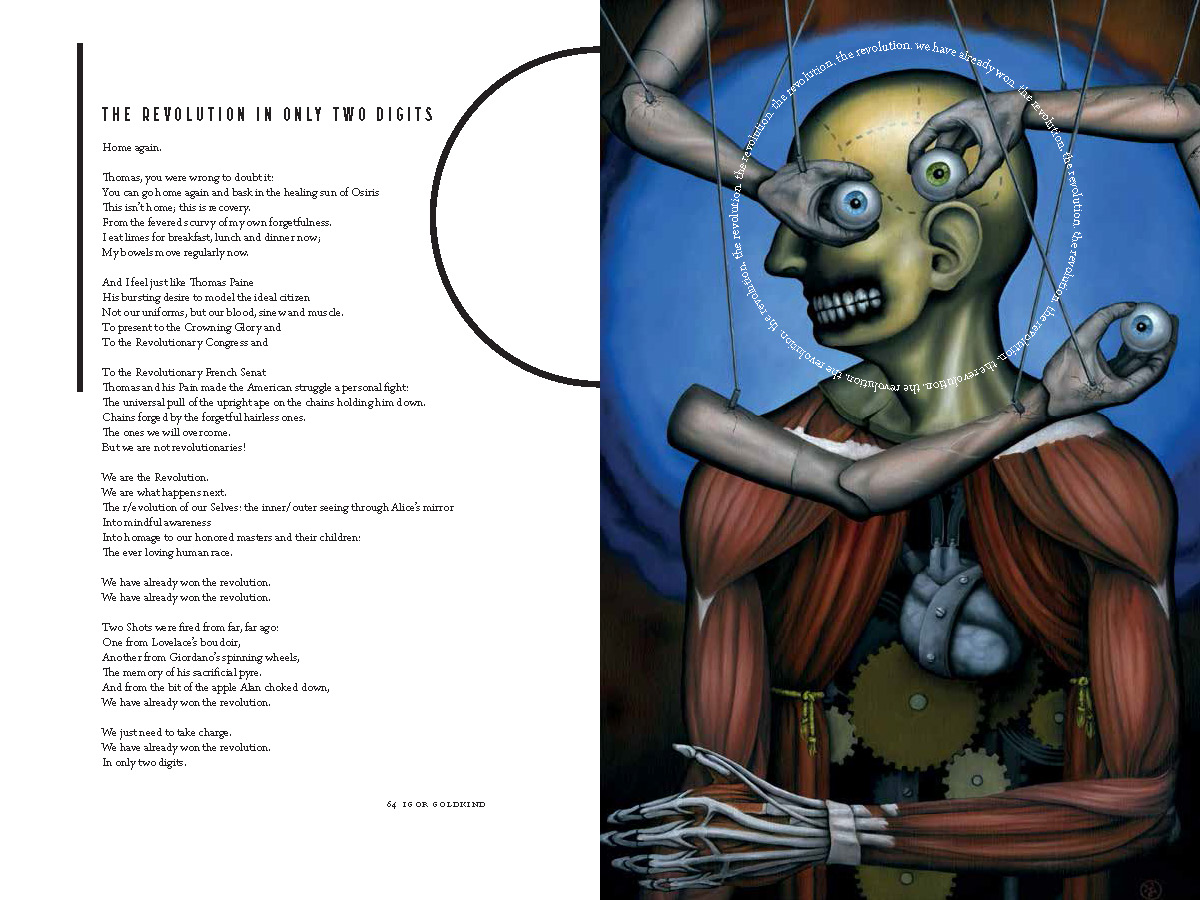



 igorgoldkind


FACING the WAVES
Share & Disseminate This With Your Friends
Like this:
March 29, 2025 | Categories: books, comments about poetry, death, Existentialism, Igor Goldkind, Illustrated books, jazz, literature, Meaning of Existence, Meditations, Mindfulness, new poetry, poetry, Poetry Therapy, Self-Therapy, sex, spoken word, Transmedia, Transmedia. multimedia, Uncategorized, world jazz music | Tags: consciousness expansion, Existence, Existential, Igor Goldkind, Jazz, literature, Love Poetry, philosophy, Poem, Poetry Therapy, Self, Spoken Word | Leave a comment